
WBN News Corp Inc.™
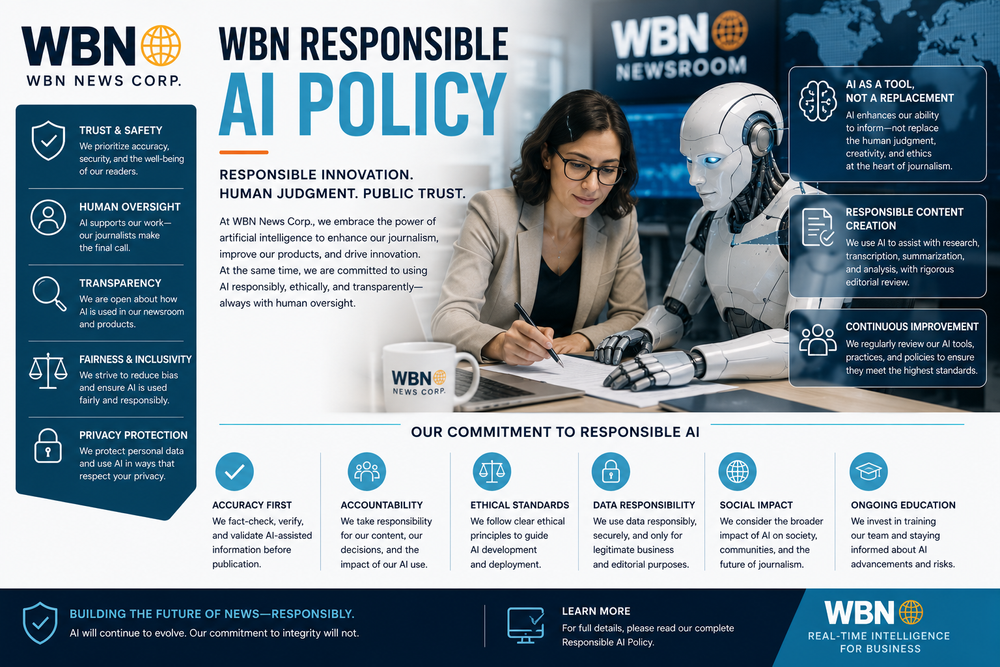
Responsible AI Policy
v1.0
Effective: June 27, 2026
Last Updated: June 27, 2026
Governs all AI systems, tools, and automated processes across WBN News Corp Platforms — including Cast OS™, SignalCast™, PromptCast™, TwinCast™, and all future AI-enabled products.
WBN Responsible AI Policy v1.0:
Human oversight on every AI system
·
Covers SignalCast™ · PromptCast™ · TwinCast™ · AI Edition · all Cast OS™ AI products
·
AI concerns: ai@wbnn.news
·
Aligned with WBN Ethics & Integrity Charter
Contents
12 sections · Click to navigate
1Our Approach to AI
2How AI Is Used at WBN
3Human Oversight & Editorial Control
4Transparency in AI Systems
5AI & Content Generation
6Personalisation & Recommendations
7Data, Privacy & AI
8Bias, Fairness & Model Integrity
9AI Security & Safety
10Third-Party AI & Partnerships
11AI Governance Structure
12Future AI & Policy Updates
1
Our Approach to AI
Artificial intelligence is not a feature at WBN News Corp — it is part of the architecture of how we operate. Our intelligence network, our editorial tools, our personalization systems, and many of our platform products are built with AI at their core. That makes our approach to AI not an optional policy position but a fundamental operational and ethical commitment.
WBN's position is straightforward: AI should make our journalism more powerful, our intelligence products more useful, and our platforms more relevant — without compromising accuracy, manipulating our audiences, or removing meaningful human judgment from decisions that matter. Where AI cannot meet that standard, we do not deploy it.
This Policy in context: The Responsible AI Policy sits alongside WBN's Ethics & Integrity Charter and Privacy Policy. Together, these three documents define the full framework within which WBN operates its AI systems. Where there is any overlap, the more specific or more protective standard applies.
🧠
AI as a Tool
AI at WBN augments human capability. It does not make autonomous decisions on matters of editorial, ethical, or personal consequence.
👁️
Always Overseen
Every AI system we deploy is subject to defined human oversight. No AI output reaches our audiences without a human accountable for it.
📣
Always Disclosed
We tell our audiences when AI has played a material role in content they are reading or tools they are using. Disclosure is non-negotiable.
⚖️
Always Accountable
When an AI system at WBN produces a harmful, inaccurate, or unfair outcome, we take responsibility for it and act to correct it.
🔄
Continuously Reviewed
Our AI systems are not set and forgotten. They are monitored, evaluated, and improved on an ongoing basis.
🚫
Bounded by Ethics
There are things WBN's AI will never do — regardless of technical capability. Those boundaries are defined in this Policy and in our Ethics Charter.
2
How AI Is Used at WBN
WBN uses AI across a range of products and functions. The following describes the current primary uses of AI within our Platforms. This list will be updated as our AI capabilities evolve.
📡 SignalCast™
AI processes and prioritizes real-time business, economic, and civic signals to surface what is most relevant. Human analysts define the signal framework and review flagged outputs.
💬 PromptCast™
AI-assisted content generation and summarization for editorial and intelligence outputs. All generated content is reviewed and approved by a human editor before publication.
🔁 TwinCast™
AI models support scenario analysis, forecasting, and simulation within our business intelligence products. Outputs are presented as analytical tools, not predictions.
🤖 AI Edition
AI curates, summarizes, and contextualizes news content for the AI Edition platform. Editorial standards apply in full. AI-generated summaries are clearly labelled.
📊 Dashboards & Analytics
AI powers the intelligence indexes, trend detection, and data visualizations within WBN's analytics and dashboard products. Methodology is documented and available on request.
🎯 Personalisation Engine
AI tailors content feeds and recommendations to individual user interests and preferences. The logic is described fully in Section 6 of this Policy.
🔍 Search & Discovery
AI enhances search relevance and content discovery across WBN Platforms. Search results are ranked on relevance and editorial quality — not engagement optimization.
🛡️ Moderation & Safety
AI assists in detecting spam, harmful content, and policy violations across community and submissions platforms. Human review is applied to all consequential moderation decisions.
What AI does not do at WBN: AI does not make final editorial decisions, determine which stories are covered or suppressed, make hiring or commercial decisions, or take any action that carries significant legal or personal consequences without human review and approval.
3
Human Oversight & Editorial Control
The single most important principle in WBN's approach to AI is this: human beings remain in control. AI can process faster, identify patterns across larger datasets, and generate content at scale — but the judgment, the accountability, and the final decision always belong to a person.
Editorial Oversight
Every piece of content that carries the WBN name — whether written by a journalist, assisted by AI, or generated by an automated system — is the editorial responsibility of a named human editor. That editor is accountable for its accuracy, fairness, and compliance with our Editorial Standards and Ethics Charter. AI does not sign off on content. People do.
Defined Escalation Points
WBN's AI systems operate within defined parameters. When an AI system encounters a situation outside those parameters — content it cannot confidently classify, a signal it cannot reliably interpret, or an output that may carry significant consequence — it escalates to a human rather than making an autonomous decision. We build these escalation points into every AI deployment as a design requirement, not an afterthought.
Human Review Requirements
- All AI-generated editorial content is reviewed and approved by a human editor before publication.
- All significant moderation decisions — those that result in content removal, account suspension, or contributor termination — are reviewed by a human.
- All AI outputs used in paid intelligence products are validated for accuracy and relevance by a human analyst before delivery.
- Any AI system flagging that could affect an individual's access to our Platforms is reviewed by a human before action is taken.
Override at Any Time
WBN's editorial and operational teams have the authority and the tools to override, pause, or shut down any AI system at any time. This capability is maintained as a standing operational requirement. We do not deploy AI systems in ways that make human override technically difficult or procedurally impractical.
4
Transparency in AI Systems
WBN is committed to being open about how AI is used in our products and what role it plays in the content and intelligence our audiences receive. We believe that transparency about AI is not just good ethics — it is a precondition of trust.
- Product-level disclosure. Every WBN product that incorporates AI includes a clear description of how AI is used in that product. That description is accessible to users and written in plain language.
- Content-level disclosure. Where AI has played a material role in generating or substantially editing a specific piece of content, that content carries a clear disclosure label. We do not present AI-generated content as independently authored human work.
- Methodology availability. The general methodology behind our AI-powered intelligence indexes, signal rankings, and analytics tools is documented and available to subscribers and partners on request. We do not require proprietary trade secrets to be disclosed, but we do not hide the basic logic of our systems behind unnecessary opacity.
- Policy updates. When WBN deploys a significant new AI capability, we update this Policy before or at the time of deployment. Our audiences are not surprised by AI capabilities they did not know existed.
- Honest about limitations. We communicate clearly when our AI systems have known limitations — including in accuracy, coverage, or context — so that users can apply appropriate judgment when relying on AI-generated outputs.
5
AI & Content Generation
WBN uses AI to assist in the creation of editorial content in specific, defined, and disclosed contexts. The use of AI in content creation is not a shortcut to lower editorial standards — it is a tool to extend our editorial capacity while maintaining those standards in full.
What AI-Assisted Content Looks Like at WBN
- Summaries and briefings. AI generates first-draft summaries of longer documents, reports, and data sets. These are reviewed, edited, and approved by a human editor before publication.
- Signal narratives. AI produces initial narrative descriptions of intelligence signals within SignalCast™ and related products. Human analysts review these before they are delivered to clients.
- Translation and localization. AI assists in translating and localizing content for WBN's global and local editions. Human review ensures accuracy and cultural appropriateness.
- Headline and metadata suggestions. AI may suggest headlines, tags, and metadata for editorial content. Final selection is made by a human editor.
What AI Will Not Do in Content
- AI will not independently publish any content to WBN Platforms without human review and approval.
- AI will not be used to generate content designed to deceive readers about its origin, authorship, or factual basis.
- AI will not be used to fabricate quotes, sources, events, or data.
- AI will not produce content that WBN's own editorial standards would prohibit a human journalist from writing.
The standard does not change. Content generated or assisted by AI is held to exactly the same accuracy, fairness, and ethical standards as content produced entirely by human journalists. The tool used to create something does not lower the bar for what it must achieve.
6
Personalisation & Recommendations
WBN uses AI to personalise the content experience for registered users — surfacing news, intelligence, and features most relevant to their professional interests, industry focus, and usage patterns. Personalisation is designed to increase relevance, not to create filter bubbles, reinforce bias, or maximise engagement at the expense of editorial breadth.
How Personalisation Works
Our personalisation engine uses your stated preferences, your content interactions, and general usage patterns to rank and surface content within your feed. It is not a closed system — content outside your typical interests remains accessible, and our platforms surface editorially significant stories regardless of personalisation signals. You remain in control of your experience.
What We Do Not Do
- We do not use personalisation to exploit emotional vulnerabilities or maximize time-on-platform through anxiety, outrage, or compulsive content patterns.
- We do not suppress editorially significant stories because they fall outside a user's apparent interests.
- We do not use personalisation data to discriminate against users or to deliver materially different quality of service based on inferred personal characteristics.
- We do not sell personalisation data or profiles to third parties for their own targeting purposes.
Your Control
Registered users can review and adjust their personalisation preferences at any time through their account settings. You can also choose to turn off content personalisation entirely and receive an editorially curated feed with no AI ranking applied. Instructions for managing these preferences are available in your account settings.
7
Data, Privacy & AI
AI systems require data to function. How that data is collected, used, and protected in the context of our AI products is governed by our Privacy Policy. This section addresses the specific intersection of data and AI at WBN.
- Data minimisation. Our AI systems are designed to use the minimum personal data necessary to achieve their purpose. We do not collect broader data than we need in order to make AI systems more capable.
- No sale of AI-derived profiles. WBN does not sell profiles, inferences, or other data derived from AI processing of user behaviour to third parties. AI-derived insights about users remain within WBN's operational environment.
- Training data standards. Where WBN uses user interaction data to improve or train its AI models, this is done on the legal basis described in our Privacy Policy, using data that has been appropriately prepared and anonymised where required. We do not use sensitive personal data to train AI models without explicit consent.
- Third-party AI training. WBN does not provide user data to third-party AI providers for model training purposes without explicit user consent and a clearly documented legal basis.
- Retention limits. Data used in AI processing is subject to the same retention limits described in our Privacy Policy. AI systems do not retain personal data beyond what is necessary for their defined function.
8
Bias, Fairness & Model Integrity
AI systems learn from data, and data reflects the world — including its inequities, its historical patterns of discrimination, and its gaps in representation. WBN takes the risk of AI bias seriously and addresses it as an ongoing operational responsibility, not a one-time technical review.
Bias Evaluation
All WBN AI systems are evaluated for bias before deployment and on a regular schedule thereafter. This evaluation considers whether AI outputs systematically favour or disadvantage any group, topic, region, or perspective in a way that is inconsistent with our editorial values. Where bias is identified, the system is adjusted before further deployment of affected capabilities.
Diversity in Training Data
Where WBN curates or prepares training data for its AI systems, we apply deliberate attention to the breadth, diversity, and representativeness of that data. We do not accept training data pipelines that we know to be systematically unrepresentative of the global audiences we serve.
Model Integrity
- WBN maintains version control and audit records for all AI models deployed in our Platforms.
- Significant changes to AI model behaviour are reviewed and approved before deployment.
- AI models are not modified in ways designed to produce commercially convenient outputs at the expense of accuracy or fairness.
- Where a model update produces unexpected or harmful outputs, the update is rolled back and reviewed before redeployment.
9
AI Security & Safety
The security and safety of WBN's AI systems is treated with the same rigour as the security of our infrastructure and the safety of our editorial content. AI systems introduce specific security risks — including adversarial manipulation, prompt injection, and model extraction — that we address through dedicated controls.
- Adversarial robustness. WBN tests its AI systems against attempts to manipulate their outputs through adversarial inputs — including prompt injection attacks on language model systems. Systems that are found to be vulnerable to manipulation are not deployed in contexts where such attacks could produce harmful outcomes.
- Access controls. Access to WBN's AI infrastructure, model weights, and training data is restricted to personnel with a defined operational need. Access is logged and reviewed.
- Output monitoring. AI outputs in deployed systems are monitored on an ongoing basis for anomalous patterns that may indicate system compromise, model drift, or unexpected behaviour.
- Incident response. WBN maintains defined response procedures for AI-related security incidents, including rapid shutdown capability for affected systems and communication protocols for notifying affected users where required.
- No autonomous escalation. WBN's AI systems do not have the capability to autonomously expand their own permissions, access new data sources, or take actions outside their defined operational scope without human authorisation.
10
Third-Party AI & Partnerships
WBN's AI capabilities include both proprietary systems built by our own teams and capabilities provided by third-party AI providers. In both cases, the standards set out in this Policy apply. Where a third-party AI provider cannot meet our standards, we do not use their technology in ways that affect our audiences.
Third-Party AI Standards
- Third-party AI providers used by WBN in audience-facing products are evaluated against our AI ethics and governance standards before engagement.
- We do not use third-party AI capabilities in ways that expose user data beyond what is described in our Privacy Policy.
- Where third-party AI providers update their models or systems in ways that could affect their behaviour within WBN products, we evaluate the impact before continuing use.
- WBN does not represent third-party AI outputs as proprietary WBN intelligence without disclosure of the underlying capability.
AI in Partner Products
Partners who distribute content or operate products within the WBN ecosystem and who use AI in those products are required to operate AI systems consistent with WBN's standards as a condition of their partnership. WBN does not permit partner AI systems to interact with WBN audiences in ways that would violate this Policy if WBN itself were operating those systems.
11
AI Governance Structure
Responsible AI practice requires more than good intentions — it requires structure, accountability, and defined processes that make ethical practice systematic rather than occasional. WBN maintains a governance framework for its AI systems that is integrated into its operational and editorial leadership.
👥
AI Review Process
All new AI capabilities and significant model updates go through a defined review process before deployment, covering ethics, safety, accuracy, and bias.
📋
Editorial Integration
AI governance is integrated into WBN's editorial leadership structure. Editorial standards apply to AI outputs with the same authority as they apply to human-authored content.
📊
Performance Monitoring
AI systems in deployment are monitored for accuracy, bias, and alignment with their defined purpose. Performance metrics are reviewed on a regular schedule.
🗂️
Audit Records
WBN maintains audit records of AI deployments, significant model changes, and AI-related incidents. These records support accountability and continuous improvement.
📣
Public Reporting
WBN publishes updates to this Policy as its AI capabilities evolve. Material changes are communicated proactively to users and partners.
🌐
WEO Alignment
WBN's AI governance framework is maintained in alignment with the World Ethics Organization's standards for responsible AI in media.
12
Future AI & Policy Updates
Commitment to Ongoing Review
AI technology is advancing faster than any fixed policy document can anticipate. WBN commits to reviewing this Policy at least annually and following any significant development in our AI capabilities, the broader AI landscape, or the regulatory environment. This Policy is a living document — it will grow with our understanding and our responsibilities.
Before deploying any new AI capability that materially affects how our audiences interact with our content or intelligence products, we will update this Policy and communicate the change clearly. Our audiences will not encounter new AI capabilities on WBN Platforms without prior notice.
Principles That Will Not Change
However AI technology evolves, the following principles are fixed and will not be revised away in future updates to this Policy:
- Human oversight of consequential AI decisions will always be maintained.
- AI-generated content will always be disclosed to our audiences.
- AI systems will never be used to deceive, manipulate, or harm the people who use our Platforms.
- WBN will always take responsibility for the outputs of AI systems operating under its name.
Contact
🤖
AI Governance
AI policy questions, concerns, and feedback:
ai@wbnn.news
ai@wbnn.news
⚖️
Ethics Office
Ethics concerns related to AI systems or outputs:
ethics@wbnn.news
ethics@wbnn.news
🔒
Privacy Office
Data and privacy questions related to AI:
privacy@wbnn.news
privacy@wbnn.news
🛡️
Trust Centre
All WBN governance documents:
wbnnewscorp.com/trust-centre/
wbnnewscorp.com/trust-centre/
WBN Responsible AI Policy™ v1.0 | WBN Cast OS™ v0.3 | 06-27-26 PST | WBN News Corp Inc.™