
By WBN Global Intelligence Desk | WBN News
Free With Your WBN Account


As H1 2026 closes, a single theme dominates the global business landscape: AI is no longer being judged on its promise — it is being judged on its performance. Markets, regulators, and capital allocators are all asking the same question at once.

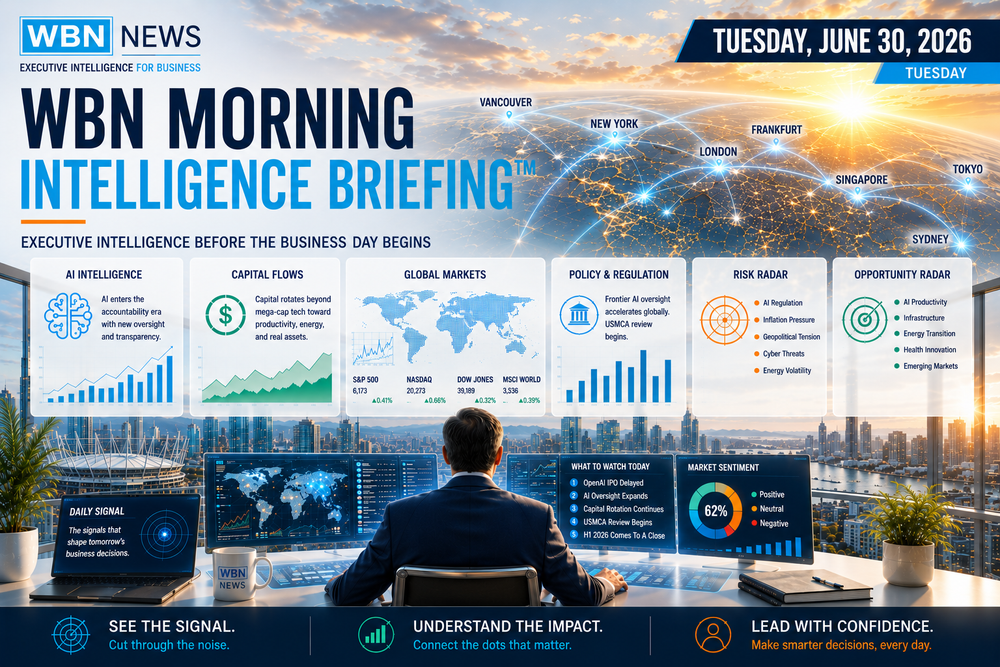
IN TODAY'S BRIEF

  • Artificial Intelligence
  • Capital Markets
  • United States
  • Global Trade
  • Europe
  • Asia-Pacific
  • Policy & Regulation
  • Capital Raising
  • Labour & Employment
  • Energy

EXECUTIVE SUMMARY

The first half of 2026 ends with a meaningful shift in how the world is relating to artificial intelligence — and what that shift means for business is only beginning to surface.

Three developments converged this week to crystallize the change. OpenAI appears likely to delay its long-anticipated IPO to 2027, unable to reconcile its $1 trillion valuation target with public market scrutiny of $38.5 billion in 2025 losses. The White House intervened directly in the release of GPT-5.6, requiring government approval of each customer before access is granted — marking the first time the US government has effectively gatekept a commercial AI product at the distribution level. And equity markets ended the week in divergence, with the Magnificent Seven under pressure while small-cap and equal-weight indexes quietly outperformed.

These are not isolated events. Together, they signal that the AI investment supercycle is entering a new phase — one where the gap between capital deployed and value delivered can no longer be papered over by narrative. Goldman Sachs projects AI-related spending will reach $800 billion by year-end. Gartner estimates worldwide AI spending at $2.59 trillion in 2026. Yet public market investors are increasingly unwilling to bid up promises without visible earnings trajectories.

On the macro side, the US economy is showing resilience on the surface — Q1 GDP was revised up to 2.1% annualized — while structural pressures accumulate beneath the surface. The June jobs report lands Thursday, July 2, with the Fed holding rates steady and watching carefully. The ECB is now fully priced for a December rate hike. Global inflation is rising faster than forecast.

Today is the last trading day of H1 2026. Leaders should be watching where capital is repositioning — not just where it has been.


TODAY'S SIGNAL

AI Is Entering The Accountability Era — And Business Must Prepare For What That Means

For the past 18 months, AI spending operated largely on faith. Hyperscalers committed hundreds of billions. Enterprise buyers deployed pilots. Investors rewarded the narrative. The question of when AI investment translates into measurable earnings growth was treated as secondary.

That is changing — and it is changing faster than most organizations have planned for.

Three forces are converging simultaneously. First, public markets are applying earnings discipline to AI valuations. OpenAI's S-1 disclosures show $38.5 billion in losses on $13 billion in revenue for 2025, with $14 billion in projected losses for 2026 despite $2 billion in monthly revenue. The IPO delay is not a financing problem — it is a signal that public-market investors will not simply extend the same grace that private rounds have afforded. Second, the government is beginning to control the distribution of frontier AI models. The White House's intervention in the GPT-5.6 release — requiring customer-by-customer government approval — establishes a new precedent. Whether framed as voluntary or not, the practical effect is that regulators now sit at the frontier between developers and enterprise customers. Third, the divergence of AI capex from measured economic output is becoming harder to ignore. Goldman Sachs estimates that AI spending adds only 0.1 percentage points to measured GDP growth, despite a 3.3-point boost to true capital expenditure growth. The gap between investment and visible productivity gain is widening.

What does this mean for business? Organizations that have treated AI adoption as a budget line rather than a strategic capability are now exposed. The companies best positioned in H2 2026 are those that can demonstrate AI is contributing to measurable operational or revenue outcomes — not just those that are spending on it. The accountability era has arrived.


FIVE THINGS LEADERS NEED TO KNOW

1. OpenAI's IPO Delay Changes The AI Capital Landscape
OpenAI's likely postponement to 2027 — with CEO Sam Altman rejecting any reduction from the $1 trillion valuation target — reflects the difficulty of reconciling massive losses with public market expectations. The immediate business impact: scarcity premium for AI exposure will concentrate in listed names like Nvidia, Microsoft, and Alphabet. Enterprise buyers should also note that a delayed IPO reduces OpenAI's near-term pressure to aggressively monetize, potentially delaying short-term price restructuring.

2. Government Is Now A Distribution Layer For Frontier AI
The White House's customer-by-customer approval requirement for GPT-5.6 access establishes that the government can position itself as an intermediary in commercial AI deployment. For enterprise technology leaders, this poses a genuine planning risk: building workflows around any single frontier model now entails regulatory dependency. Organizations procuring AI at the frontier need government relations and compliance strategies they did not need six months ago.

3. Markets Are Quietly Rotating Away From Mega-Cap Tech
The S&P 500 Equal Weight Index is showing new relative strength; the Russell 2000 is outperforming the Nasdaq 100 year-to-date by approximately 4 percentage points; and 63% of S&P 500 stocks now trade above their 50-day moving average — up from 50% at the start of June. This expansion in breadth suggests institutional rotation, not a market collapse. Leaders with concentrated exposure to large-cap tech should monitor this shift.

4. The USMCA Review Arrives In July
The first joint USMCA review is scheduled for July 2026, and the outcome carries material implications for North American supply chains. The US wants reshoring and leverage. Mexico wants market access and predictability. Canada is actively diversifying trade relationships beyond the US. Any outcome that elevates uncertainty will increase working capital requirements for companies operating cross-border.

5. Europe's Inflation Problem Is Getting Worse
The ECB has revised its 2026 headline inflation forecast to 3.0%, up from earlier projections, and markets are fully priced for a December rate hike — with some probability of an earlier move if June flash data disappoints. European borrowing costs are rising at a moment when the continent's consumer confidence is already below consensus. Companies with European exposure should factor higher financing costs and softer consumer demand into their H2 planning.


MARKET INTELLIGENCE

Equities: Global equity markets are closing H1 2026 in a state of divergence. The Nasdaq 100 and S&P 500 are on pace for weekly losses, weighed by pressure on the Magnificent Seven. The Russell 2000 is outperforming year-to-date, up approximately 21% versus roughly 17% for the Nasdaq 100. The equal-weight S&P 500 is strengthening, with advancing stocks outnumbering declining ones even on down days — a sign of healthy rotation rather than broad deterioration. The ASX 200 is closing H1 up just 0.5%, pressured by RBA rate hikes, elevated inflation, fallout from the Middle East conflict, and commodity weakness.

Bonds: Treasury yields have dipped slightly, providing support for rate-sensitive sectors and contributing to the equal-weight S&P 500's recent strength. The direction of July's yield movement will depend heavily on Thursday's jobs report. European bond markets are pricing for ECB tightening later this year.

Oil: Crude prices have continued to ease, benefiting from apparent progress in Middle East peace negotiations following the April ceasefire in Iran. Lower oil prices are supporting the broader equal-weight index while easing inflation pressure — though energy sector weakness is dragging on commodity-heavy markets like Australia.

Gold: Commodity weakness, including in gold, has pressured materials sectors globally, with the ASX 200 materials index falling approximately 3.6% for the week.

Currencies: The US dollar continues its gradual structural decline, consistent with analyst forecasts heading into 2026. A weaker dollar supports multinational earnings when translated back into USD but also reflects longer-term structural instability that currency risk managers should monitor.

Market Sentiment: The rolling 52-week correlation between the cap-weighted and equal-weight S&P 500 is at its lowest since 2003. This is not a warning sign — it is a structural rotation signal. Credit markets remain healthy, with spreads low across the board.


AI INTELLIGENCE

The defining AI story of this week — and possibly this half-year — is the convergence of government intervention and capital market discipline arriving at the same moment.

The White House required that OpenAI's GPT-5.6 release proceed through a customer-by-customer government approval process, coordinated by the Office of the National Cyber Director and the Office of Science and Technology Policy. This follows a June 2 executive order establishing a voluntary review framework for frontier AI developers, and similar restrictions previously applied to Anthropic models. The practical effect: enterprise customers approved first will gain a meaningful competitive advantage in accessing OpenAI's most capable model to date. Those who have not established government-aligned procurement processes may wait.

For enterprise AI strategy, the implications are significant. Regulatory friction does not broadly slow AI — worldwide AI spending is projected at $2.59 trillion in 2026, up 47% year-over-year, per Gartner. But it reshapes how frontier capability reaches the market. Organizations that treat AI procurement as a purely commercial transaction now face a government-mediated layer at the most capable tier.

Stanford's HAI 2026 AI Index estimates that the US consumer surplus from generative AI reached $172 billion annually by early 2026, growing 54% in the past year. Productivity gains are real and accelerating. The business question for H2 2026 is not whether AI delivers value — it is whether the organizational and regulatory infrastructure exists to capture that value at scale.


CAPITAL & INVESTMENT WATCH

OpenAI IPO: The anticipated September 2026 IPO window is closing. Reports from the New York Times, Reuters, and The Information confirm OpenAI is leaning toward a 2027 listing to protect its $1 trillion valuation target. CEO Sam Altman has rejected any reduction in valuation as a precondition for a faster listing. The confidential S-1 filed June 8 remains with the SEC. Prediction market Kalshi prices one-in-three odds of a 2026 IPO announcement and approximately 73% odds by June 2027.

Anthropic: Anthropic separately filed a confidential S-1 in early June. Kalshi traders currently price a 70% probability of an official Anthropic IPO announcement by December 2026.

SpaceX: SpaceX's recent public debut — described as the first of what was expected to be several mega-cap IPOs this year — experienced an initial rally followed by a pullback, which OpenAI advisers reportedly cited as a reason for caution.

AI Infrastructure: Goldman Sachs projects AI-related capital expenditure will boost true capex growth by approximately 3.3 percentage points in 2026. Morgan Stanley estimates nearly $3 trillion in AI-related infrastructure investment will flow through the global economy by 2028, with more than 80% still ahead. Capital is flowing into data centers, power infrastructure, memory storage, and software platforms — not just semiconductors.

China FDI: China's year-to-date foreign direct investment fell 8.6% year-on-year through May, though the result was better than the 11% decline markets had anticipated.


POLICY & REGULATION

AI Governance: The June 2 White House executive order establishing a voluntary pre-release review framework for frontier AI models is being applied in practice as a mandatory gating mechanism. The intervention in GPT-5.6's distribution — the first of its kind for a commercial AI product — establishes a precedent that technology leaders should take seriously regardless of jurisdiction.

Trade: The USMCA's first joint review is scheduled for July 2026. Separately, the US Supreme Court struck down the legal basis for many 2025 IEEPA tariffs in February 2026, and the administration responded with a 10% across-the-board tariff under alternative legal authority, which was later raised to 15%. The average effective US tariff rate is now at its highest since the Great Depression. Non-tariff barriers are also rising globally — subsidies, local-content requirements, export controls, and investment screening are all increasing.

Europe: The ECB revised its 2026 headline inflation forecast to 3.0% and its 2027 forecast to 2.3%. The market is fully priced for a 25-basis-point rate hike at the December meeting, with some probability of earlier action depending on the June flash estimate.

Labor: US initial jobless claims fell to 215,000 for the week ending June 20, beating consensus, while continuing claims edged higher. The June jobs report (due Thursday, July 2) will be a critical input to Fed thinking on rate policy.


OPPORTUNITY RADAR

AI Infrastructure Beyond Semiconductors: The AI capital cycle is broadening. Data centers, power infrastructure, memory storage, and software platforms are all receiving major investment flows. Companies enabling AI infrastructure at the non-chip layer are increasingly well-positioned.

Equal-Weight and Small-Cap Equities: The rotation away from mega-cap tech toward broader market participation is creating opportunities in industrials, financials, and consumer discretionary — sectors overshadowed by the AI narrative but benefiting from lower yields and resilient credit conditions.

Supply Chain Resilience Services: KPMG's 2026 CEO Outlook Pulse Survey found nearly three-quarters of CEOs made strategic adjustments for agility last year, and two-fifths are planning further agility investments this year. Companies providing supply chain mapping, contingency sourcing, and tariff scenario planning are in structurally growing demand.

Government-Aligned AI Procurement: The new US framework for frontier AI distribution creates a competitive advantage for organizations that establish government-approved procurement processes early. Advisers, compliance firms, and technology integrators with relevant government relationships are well-positioned.

Emerging Market Trade Corridors: With US-China trade fragmentation deepening, interregional trade outside Asia — particularly between Africa and Latin America — remains significantly underdeveloped. UNCTAD identifies strengthening South-South linkages as a key emerging driver of growth.


RISK RADAR

AI Valuation Correction: OpenAI's financials — $38.5 billion in 2025 losses, $14 billion projected for 2026, and a $600 billion infrastructure commitment through 2030 — illustrate the capital intensity of the AI buildout. If public markets apply earnings discipline to these metrics, a broader AI valuation reset could affect both traded names and private valuations, as well as enterprise procurement budgets.

Regulatory Intervention in AI Distribution: The GPT-5.6 precedent is material. If government approval becomes a normalized step in frontier AI deployment, enterprise roadmaps that depend on timely model access face a new category of scheduling and compliance risk.

European Inflation And Rate Risk: The ECB's upward revision to 2026 inflation forecasts — now 3.0% headline — combined with lower consumer confidence, creates a stagflationary risk environment for European operations. Companies with eurozone exposure should stress-test H2 plans against higher borrowing costs.

USMCA Review Uncertainty: The July review of the US-Mexico-Canada Agreement introduces the possibility of major renegotiation. Any outcome that increases tariff uncertainty along the North American corridor will raise working capital requirements and complicate cross-border procurement planning.

Geopolitical Trade Fragmentation: McKinsey's 2026 trade analysis identifies geopolitical conflict and tariff instability as continuing to reshape global trade networks. With the average US effective tariff rate at a generational high and non-tariff barriers rising globally, supply chain planning horizons are shortening for most multinational operators.

Labour Market Softening: US continuing jobless claims rising to 1.821 million alongside steady initial claims suggest a gradual softening in labor market conditions.


WHAT TO WATCH TODAY

Today — June 30: Last trading day of H1 2026. No major data releases expected. Watch for any end-of-quarter institutional repositioning in equity markets, particularly the continued divergence between cap-weighted and equal-weight indexes.

Tomorrow — July 1: June consumer confidence data. May JOLTS job openings. Earnings from Nike (NKE) and Constellation Brands (STZ). ADP June employment change. June ISM Manufacturing PMI. June construction spending.

Thursday — July 2: June nonfarm payrolls, unemployment rate, and hourly earnings. This is the marquee data release of the week and will materially affect Fed rate expectations for the remainder of 2026.

July (ongoing): USMCA first joint review begins. Watch for any early signals on US negotiating positions.

AI: Monitor for any government statements from the Office of the National Cyber Director or OSTP clarifying the GPT-5.6 access timeline and approval criteria.


EXECUTIVE TAKEAWAYS

  • Watch the June jobs report on July 2 — a number that surprises to the upside keeps Fed rate pressure elevated; a miss reopens the rate-cut debate and will move markets.
  • Expect AI regulation to become a standard planning variable for technology procurement teams, not an edge case — the GPT-5.6 intervention is a precedent, not an anomaly.
  • Prepare North American supply chain scenarios for USMCA review outcomes, including elevated uncertainty, renegotiation timelines, and potential additional tariff variability through H2.
  • Consider whether your AI investments have visible productivity or revenue outcomes attached to them — the accountability era has arrived, and boards and investors will increasingly demand evidence of return, not just spending.
  • Monitor the ECB's June flash inflation estimate closely — a hotter-than-expected core print could accelerate the timeline for European rate hikes and increase financing costs across eurozone operations.

CONCLUSION

The close of H1 2026 marks a genuine inflection point. The AI investment supercycle that defined the past 18 months is not ending — but it is maturing, and that maturation looks different from what the market has been pricing. Capital discipline, government oversight, and earnings scrutiny are arriving simultaneously. At the same time, the broader economy is quietly demonstrating resilience: labor markets are holding, credit spreads are tight, and market breadth is expanding even as mega-cap tech consolidates. The leaders best positioned for H2 are those who can separate signal from noise — who understand that the AI accountability era is not a headwind to AI adoption, but a filter that will reward organizations that have built genuine operational capability over those that have accumulated spending and press releases. Today's signal is clear: the era of AI-on-faith is over. The era of AI on evidence has begun.


WBN Global Intelligence Desk
WBN News – Executive Intelligence For Business
Subscribe Free With A WBN Account


TAGS: #MorningIntelligenceBriefing #ArtificialIntelligence #GlobalMarkets #OpenAI #AIRegulation #CapitalMarkets #TradePolicy #USMCA #FederalReserve #ECB #MacroEconomics #TechIPO #SupplyChain #BusinessIntelligence #ExecutiveBriefing


FACT CHECK

Verified facts used in this briefing:

  • US Q1 2026 GDP revised to 2.1% annualised (from 1.6%) — BLS/BEA reported
  • US May nonfarm payrolls: +172,000; unemployment rate: 4.3% — BLS Employment Situation, June 5, 2026
  • US initial jobless claims for week ending June 20: 215,000; continuing claims: 1.821 million — reported
  • ECB revised 2026 headline inflation forecast to 3.0%, 2027 to 2.3% — ECB reported
  • OpenAI 2025 net loss: $38.5 billion on $13.07 billion in revenue — disclosed in S-1 reporting
  • OpenAI projected 2026 losses: approximately $14 billion — reported
  • OpenAI's monthly revenue pace: approximately $2 billion as of March 2026 — reported
  • OpenAI confidential S-1 filed with SEC: June 8, 2026 — confirmed
  • OpenAI valuation target: up to $1 trillion — reported by multiple sources
  • Goldman Sachs AI-related spending forecast: $800 billion by year-end 2026 — reported
  • Gartner 2026 AI spending projection: $2.59 trillion, up 47% YoY — Gartner reported
  • Russell 2000 YTD performance: approximately +21% — reported
  • Nasdaq 100 YTD performance: approximately +17% — reported
  • ASX 200 H1 2026 gain: approximately +0.5% — reported
  • China FDI YTD: -8.6% YoY through May — reported
  • Kalshi prediction market: ~33% odds of 2026 OpenAI IPO, ~73% by June 2027 — Kalshi/CNBC reported
  • June 2 White House executive order on frontier AI review — confirmed
  • GPT-5.6 customer-by-customer government approval process — reported by The Information, Reuters
  • US Supreme Court ruling on IEEPA tariffs: February 2026 — confirmed
  • Stanford HAI 2026: US AI consumer surplus $172 billion, up 54% — Stanford HAI 2026 AI Index

EDITORIAL DISCLAIMER

The WBN Morning Intelligence Briefingâ„¢ is prepared by the WBN Global Intelligence Desk using multiple reputable sources, verified data, and editorial review. While every effort is made to ensure accuracy, information is believed correct at the time of publication and may change as events develop. This briefing is intended for general business intelligence purposes only and does not constitute financial, legal, investment, or professional advice. Readers should conduct their own due diligence before acting on any information contained herein. For complete Editorial Standards, AI Governance Policy, Source Methodology, and Legal Notices, visit the WBN Trust Centre.

Share this article
The link has been copied!