By WBN Global News Desk | WBN News
Subscribe Here: | June 29, 2026

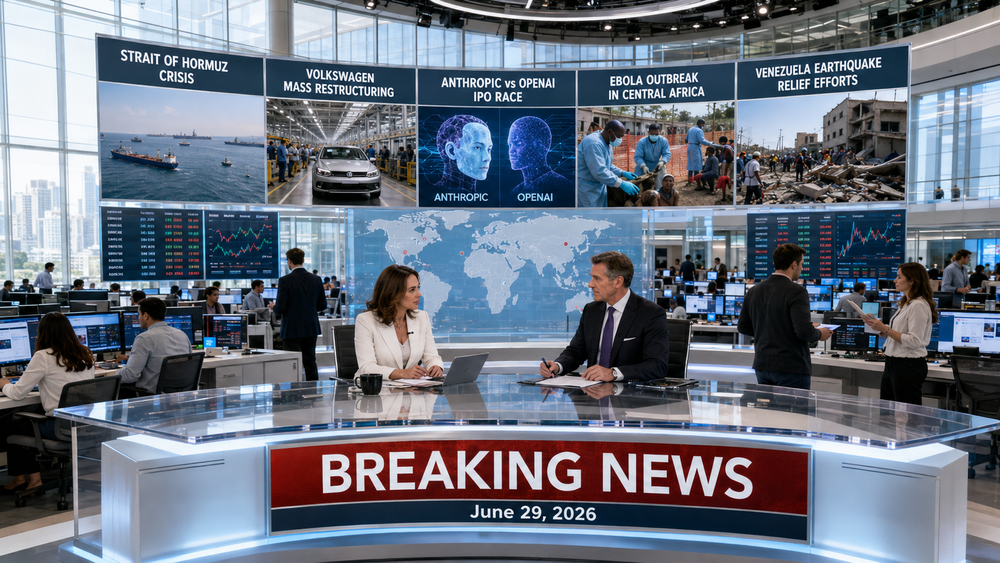
The US-Iran ceasefire hangs by a thread as fresh drone strikes in the Strait of Hormuz send oil markets into renewed turmoil, while the AI IPO race quietly splits in two — Anthropic racing toward an October debut as OpenAI steps back to 2027. Volkswagen's planned elimination of up to 100,000 jobs signals a historic restructuring of European industry, Venezuela reels from twin earthquakes, and the Ebola outbreak in central Africa continues to expand.

The world is entering the second half of 2026 under pressure. Geopolitical risk is repricing energy, the AI investment cycle is being stress-tested, and two simultaneous humanitarian emergencies — one geological, one biological — are straining institutions already stretched thin by months of conflict.


📌 At A Glance

  • US and Iran agree to stand down after fresh drone strikes in the Strait of Hormuz; Doha talks scheduled for Tuesday
  • OpenAI signals 2027 IPO while Anthropic targets October listing, potentially becoming the first trillion-dollar AI IPO in history
  • Volkswagen plans to cut up to 100,000 jobs and close four German plants in what could be the largest restructuring in the automaker's 89-year history
  • Venezuela's twin earthquakes on June 24 have killed at least 1,430 people; the death toll is feared to rise significantly
  • Ebola outbreak in DRC and Uganda surpasses 1,155 confirmed cases, becoming the third-largest Ebola outbreak on record

⭐ Top Story

Headline: US-Iran Standoff In The Strait Of Hormuz Renews Energy Market Fears

Source: CBS News / CNN / Al Jazeera

Summary: After Iran launched drone strikes on commercial vessels in the Strait of Hormuz last week — including a hit on the Singapore-flagged Ever Lovely — the US struck Iranian missile and radar sites in retaliation. By Sunday, both sides agreed to stand down temporarily, with talks scheduled in Doha on Tuesday. Iran's Foreign Minister warned that any deviation from the memorandum of understanding signed on June 17 would increase tensions and delay the reopening of the strait. US gas prices sit at $3.87 per gallon, still up 40% year over year. Analysts say prices are unlikely to return to pre-war levels before late 2026 at the earliest — and possibly not until 2027.

Why It Matters: The Strait of Hormuz carries roughly 20% of the world's seaborne oil and LNG. Every escalation resets the energy cost baseline for global business, delays rate relief from central banks, and extends inflationary pressure into consumer spending. With US midterms approaching in November, the political stakes are compounding the economic ones.


🍁 Canada

Headline: CUSMA Review Looms As Canada's Economy Sits On Pause

Source: Global News / Deloitte Canada

Summary: Canada's economy entered a technical recession in late 2025, and as the CUSMA trade agreement approaches its July 1 review, businesses remain in a holding pattern. Deloitte projects annualized GDP growth of just 0.7% in 2026, with business investment subdued and confidence low pending trade clarity.

Why It Matters: The CUSMA review is the single biggest near-term risk to Canada's economic recovery — a failure to extend the agreement or further US tariff escalation would deliver a material blow to exports and business investment at a time when the economy can least absorb it.

Headline: Canada Positioned As Energy Alternative Amid Middle East Disruption

Source: RBC Economics / Canada Spring Economic Update 2026

Summary: As Hormuz supply disruptions persist, demand for Canadian crude has increased, improving Canada's terms of trade. Parliamentary Budget Office data confirms elevated oil prices are lifting national income, partially offsetting broader economic headwinds.

Why It Matters: Canada's status as a stable, Western-aligned energy supplier is becoming a strategic asset — one with the potential to attract long-term capital investment if the country can expand pipeline and export infrastructure fast enough to meet the moment.


🦅 United States

Headline: US Consumer Sentiment Edges Up, But Inflation Expectations Remain Elevated

Source: University of Michigan / Trading Economics

Summary: The University of Michigan Consumer Sentiment Index was revised upward to 49.5 for June — still well below the 63.6 recorded a year ago — as easing gasoline prices provided some relief. Year-ahead inflation expectations remain at 4.6%, down slightly from May's 4.8% but far above pre-conflict levels.

Why It Matters: With sentiment still near historic lows and inflation expectations anchored above 4%, the Federal Reserve faces a difficult path. Any renewed escalation in the Hormuz escalation could reverse June's modest improvement and push rate-cut expectations further into the future.

Headline: PCE Inflation Rises To 4.1% In May As Energy Costs Broaden Into Core

Source: US Bureau of Economic Analysis / Trading Economics

Summary: The Personal Consumption Expenditures price index rose to 4.1% year-over-year in May 2026, up from 3.8% in April, as energy cost pressures extended into food and services. The Fed's preferred inflation measure now sits at more than double its 2% target.

Why It Matters: A PCE reading above 4% locks the Fed into a restrictive stance heading into summer. Businesses face higher borrowing costs, consumer spending faces further compression, and the window for meaningful rate relief in 2026 is closing rapidly.


🌍 Africa

Headline: Ebola Outbreak In DRC And Uganda Becomes Third-Largest On Record

Source: ECDC / WHO / CDC

Summary: As of June 26, the DRC Ministry of Health reported a total of 1,155 confirmed cases, including 304 confirmed deaths, with 385 individuals hospitalized in isolation. The outbreak, caused by the Bundibugyo strain of Ebola — for which there is no licensed vaccine or specific treatment — has spread across three provinces in the DRC and into Uganda's capital Kampala. The G7 summit in June committed over $1 billion toward the response. European Centre for Disease Prevention and Control

Why It Matters: The absence of a licensed vaccine for the Bundibugyo virus transforms this outbreak into a race between containment and spread. Armed conflict in Ituri, a highly mobile cross-border population, and strained health infrastructure mean the outbreak trajectory remains deeply uncertain — and the risk of business and travel disruption extends well beyond the region.

Headline: Africa CDC And WHO Launch Continental Ebola Preparedness Plan

Source: WHO / Africa CDC

Summary: Africa CDC and the WHO jointly launched a continental strategic preparedness and response plan on June 5, with vaccine candidates from the Coalition for Epidemic Preparedness Innovations now in accelerated development. The US has committed $112 million in bilateral assistance.

Why It Matters: The continent-wide response framework signals that health authorities are treating this as a systemic risk, not an isolated outbreak. For investors and businesses operating across sub-Saharan Africa, the outbreak is now a supply chain, labor, and operational risk factor requiring active monitoring.


🌎 International

Headline: Venezuela's Twin Earthquakes Kill More Than 1,400 With Thousands Still Missing

Source: Wikipedia / PAHO / Direct Relief

Summary: On June 24, two large earthquakes — a magnitude 7.2 foreshock followed 39 seconds later by a magnitude 7.5 mainshock — struck northwestern and central Venezuela, killing at least 1,430 people, injuring over 3,238, and leaving more than 68,900 people reported missing. Caracas and La Guaira were severely affected, with over 100 buildings collapsing. A state of emergency is in effect. Wikipedia

Why It Matters: Venezuela's humanitarian and economic situation was fragile before the earthquakes. The disaster compounds an already severe governance and infrastructure crisis, is likely to require sustained international aid, and creates additional pressure on an oil-producing nation at a moment when global energy markets are already strained.

Headline: Iran And US Agree Temporary Stand-Down As Doha Talks Set For Tuesday

Source: CNN / CBS News

Summary: Both sides agreed to stand down after an exchange of fire near the Strait of Hormuz over the weekend; talks between US and Iranian officials are scheduled in Doha, Qatar, on Tuesday. Iran's foreign minister reiterated that any parallel arrangements outside the memorandum of understanding would only delay the strait's reopening. CNN

Why It Matters: The ceasefire framework signed on June 17 set a 60-day window to negotiate a final deal. Each exchange of fire erodes that window and raises the cost of failure — for energy markets, global trade, and the broader regional stability that investors and businesses depend on.


🇦🇷 Latin America

Headline: Venezuela Earthquake Devastates Economy Already Under Severe Strain

Source: PAHO / Wikipedia / Direct Relief

Summary: The Venezuelan government has declared a state of emergency following the June 24 earthquakes, with critical infrastructure — including power and communications — knocked out across multiple states. Estimates suggest up to 3.9 million people were exposed to severe shaking.

Why It Matters: Venezuela's oil production and export capacity could be affected at a time when global supply is already constrained by the disruption at the Strait of Hormuz. The humanitarian cost will require sustained international support, diverting resources from other regional priorities.

Headline: Latin America Watches CUSMA And US Trade Policy With Growing Concern

Source: Global Affairs Canada / Oxford Economics

Summary: As the CUSMA review reaches its July 1 trigger date, Latin American economies that have benefited from supply chain diversification away from China are watching closely. Mexico, in particular, faces uncertainty about whether the current low-tariff environment will hold.

Why It Matters: A deterioration in North American trade relations would reverberate across Latin American supply chains and investment flows, with Mexico and Central America most exposed to a shift in US trade posture.


🇪🇺 Europe

Headline: Volkswagen Plans To Cut 100,000 Jobs And Close Four German Plants

Source: Reuters / Euronews / Business Standard

Summary: Volkswagen is reportedly preparing what could be the most radical overhaul in its history, with up to 100,000 jobs cut worldwide and four German plants potentially closed — including facilities in Hanover, Zwickau, and Emden, as well as an Audi plant in Neckarsulm. In the first quarter of 2026, the group's net profit fell 28% to €1.56 billion, while revenue declined 2%, with US tariffs costing approximately €4 billion per year and China sales down 20%. EuronewsEuronews

Why It Matters: Volkswagen employs roughly 660,000 people globally. A restructuring of this magnitude would ripple through German and European automotive supply chains, threaten regional employment, and signal a fundamental shift in the competitive position of European legacy automakers relative to Chinese EV rivals.

Headline: UK Prime Minister Starmer Vows To Fight Leadership Challenge As Political Pressure Mounts

Source: CNBC / Fidelity Market Reports

Summary: UK Prime Minister Keir Starmer has pledged to stand in any Labour leadership contest after challenger Andy Burnham secured a dominant by-election victory in Makerfield, winning nearly 55% of the vote and signalling broad dissatisfaction with the current government.

Why It Matters: Political instability in the UK adds uncertainty to business investment decisions at a time when the country is navigating elevated inflation, a sluggish growth outlook, and the lingering effects of energy price shocks. Bond markets have already begun watching UK political developments closely.


🌏 Asia-Pacific

Headline: Asian Markets Stabilize, But Technology Stocks Remain Under Pressure

Source: CNBC / IC Markets

Summary: Asia-Pacific markets traded mixed on Monday, with Japan's Nikkei 225 down 0.35%, Hong Kong's Hang Seng advancing, and Australia's S&P/ASX 200 gaining 0.41%. Technology stocks remain the primary drag, while energy and materials sectors have been more resilient amid oil price uncertainty. CNBC

Why It Matters: The rotation out of technology and into defensive sectors reflects investor concern about AI return-on-investment timelines — a trend that, if sustained, will tighten capital availability for AI infrastructure spending and put downward pressure on the valuations underpinning planned AI IPOs.

Headline: South Korea's Kospi Recovers From 10% Flash Crash As Chip Sector Rebounds

Source: CNBC

Summary: South Korea's Kospi jumped more than 3% after posting a 10% fall the previous session, with SK Hynix rising 2.7% and Samsung Electronics gaining over 8%. The sharp rebound followed a sell-off driven by fears about the sustainability of AI demand and rising memory chip costs. CNBC

Why It Matters: South Korea's chip sector is a leading indicator for global AI hardware investment. Extreme volatility in Samsung and SK Hynix suggests the market has not yet formed a settled view of the durability of AI infrastructure spending — a question that will define capital allocation decisions for years to come.


🤖 Artificial Intelligence

Headline: OpenAI Signals 2027 IPO As Anthropic Races To October Listing

Source: Bloomberg / CNBC / Yahoo Finance

Summary: OpenAI is considering delaying its IPO until 2027, with leadership expecting Anthropic to go public first, even though both companies have already filed confidentially with the SEC. Anthropic, last valued at $965 billion, filed confidential S-1 paperwork on June 1 and is targeting an October Nasdaq listing — potentially the first company to debut on public markets at a $1 trillion valuation. BloombergYahoo Finance

Why It Matters: Anthropic's October IPO would set the public market multiple for AI inference revenue. If that benchmark disappoints, OpenAI's 2027 listing faces a harder pricing environment. Together, these two listings represent the most consequential capital market events in AI history — and the market's verdict will shape the pace and direction of AI investment globally.

Headline: AI Sector Faces Growing Scrutiny Over Return On Investment And Regulatory Risk

Source: NPR / Schwab Market Update / IndMoney

Summary: Wall Street's AI trade is under stress. Worries about spiraling AI costs and a possible delay in OpenAI's IPO have weighed on tech stocks, with hyperscaler stocks from Microsoft, Amazon, and Alphabet underperforming chip names as they face rising costs to expand their AI data centers. Export control actions, regulatory headwinds, and slowing agentic spending compound the uncertainty. Charles Schwab

Why It Matters: After more than $580 billion in corporate AI investment in the past year alone, the market is demanding evidence of returns. The answer to that question — and the regulatory environment in which it unfolds — will determine whether 2026 marks the beginning of AI's productivity era or the peak of its investment cycle.


💹 Markets

Headline: Oil Prices Volatile As Hormuz Situation Remains Unresolved

Source: CNBC / Al Jazeera

Summary: Brent crude settled near $73–$79 per barrel last week, well below the $100 peak reached at the height of the conflict but still up significantly from pre-war levels. Energy prices in the US have risen 7.7% over the last two months alone and are up 40% year over year, according to the Bureau of Labor Statistics. Analysts say full-price normalization is unlikely before late 2026 at the earliest. Al Jazeera

Why It Matters: Elevated oil prices are embedding a persistent inflation premium into the global economy. Until the Hormuz situation is fully resolved and shipping traffic normalizes, central banks will remain in a holding pattern — and business investment planning will be constrained by cost uncertainty.

Headline: Tech Sell-Off Drives Sector Rotation As S&P 500 Equal Weight Outperforms

Source: Schwab Market Update

Summary: Though the Nasdaq and S&P 500 have struggled in recent sessions as tech sagged, advancing shares have continued to outnumber declining ones, with investors rotating into sectors beyond tech — a trend reflected in the S&P 500 Equal Weight Index outperforming the standard benchmark. Charles Schwab

Why It Matters: Market breadth improving while tech falls is a structurally important signal. It suggests investor confidence in the broader economy persists even as AI valuations are questioned — which matters for capital allocation, sector leadership, and the inflation outlook heading into the second half of 2026.


📈 IPOs & Capital Raising

Headline: Anthropic Targets October IPO At Potential $1 Trillion Valuation

Source: Bloomberg / IndMoney

Summary: Anthropic filed its confidential S-1 with the SEC on June 1 and is targeting an October Nasdaq listing. The company has reported approximately $47 billion in annualized revenue and is on track for its first profitable quarter. If Anthropic's IPO values the company below $965 billion — its last private round — Amazon and Alphabet may need to record write-downs; above it, they could book further gains. INDmoney

Why It Matters: The Anthropic IPO is not just a capital markets event — it is a direct trigger for Big Tech earnings across Amazon and Alphabet, a pricing benchmark for all AI companies, and a referendum on whether the AI investment supercycle has created durable enterprise value.

Headline: OpenAI Delays IPO To 2027 After SpaceX Market Lesson

Source: CNBC / Reuters / Bloomberg

Summary: Traders on the prediction market Kalshi now place only about a 1-in-3 odds of an OpenAI IPO being announced before January 1, with a 59% probability by March 2027. CEO Sam Altman has reportedly set a hard floor of $1 trillion for a listing valuation. The decision follows SpaceX's IPO, which peaked at $225 before retreating 32%. CNBC

Why It Matters: OpenAI's delay hands Anthropic a first-mover pricing advantage in what may be the most significant IPO pairing in market history. The second mover will be priced against a benchmark it did not set, in a market that will have had months to form a view on AI's public market multiple.


Why It All Matters

Today's stories share a single underlying theme: the world's tolerance for uncertainty is being tested simultaneously across energy, technology, geopolitics, and public health — and each domain is feeding back into the others.

The Strait of Hormuz is the central fault line. As long as that waterway remains contested, oil prices stay elevated, inflation stays above target, and central banks stay on hold. That keeps borrowing costs high at the precise moment when AI companies, automakers, and emerging market economies most need affordable capital.

The AI IPO split is more significant than it appears. Anthropic and OpenAI listing in different years means the market will price AI twice — once in October 2026 and again in early 2027. The first verdict will shape the second. If Anthropic's debut disappoints, OpenAI's timeline and valuation floor come under pressure. If it succeeds, the AI infrastructure spending cycle gets a powerful endorsement just when investor confidence is wobbling.

Volkswagen's restructuring is Europe's version of the same problem. The automaker is being squeezed simultaneously by US tariffs, Chinese competition, and the energy cost shock from the conflict in Iran. One hundred thousand jobs at risk are not just a German story — they are a warning about the structural fragility of legacy manufacturing in an era of geopolitical disruption and accelerated technological change.

And running beneath all of this are two humanitarian emergencies — Venezuela's earthquake and the Ebola outbreak in central Africa — that will consume international resources, test institutional capacity, and create secondary economic effects that will be underestimated until they are not.

The second half of 2026 begins with the world's major risk systems under simultaneous strain. What happens next will depend on whether the Hormuz ceasefire holds, whether the AI IPO market validates the investment supercycle, and whether the institutions managing the DRC outbreak and Venezuela's reconstruction can move fast enough to contain cascading effects.


WBN Global News Desk
WBN News – Real-Time Intelligence For Business

Subscribe Here:
https://wbn.digital?fpr=george75

Contact:
newsdesk@wbnn.news

LinkedIn:
https://www.linkedin.com/in/georgemoen/


Editorial Disclaimer

WBN Breaking News is an AI-assisted publication prepared by the WBN Global News Desk using multiple reputable sources and editorial review. Information is believed to be accurate at the time of publication, but may change as events develop; for complete Editorial Standards, AI Governance, and Legal Notices, please visit the WBN Trust Center.


Tags:
#Breaking News #Strait of Hormuz #Artificial Intelligence #Volkswagen #Venezuela #Ebola #OpenAI #Anthropic #Oil Markets #Global Economy

Share this article
The link has been copied!