
Founder's Vision · Version 1.0 · July 2026
The Community
Operating System
One account. Many homes. Every town, every neighbourhood, every organization — connected, and owned by the people who live there.
HOMETOWN™
PREPARED FOR INVESTORS & STRATEGIC PARTNERS
Contents
00Executive SummaryWhere we are, and where this goes
01The Core VisionNot another social network
02HomeTown Social™The Community Operating System
03HomeTown Workspace™The Personal & Business Operating System
04WBN News™The News Operating System
05HomeTown Business™Every business gets a Home
06HomeTown Groups™Where interest becomes community
07HomeTown Guides™The human layer
08HomeTown Marketplace™Community Commerce
09HomeTown AI™Woven in, not bolted on
10IdentityOne person, unlimited belonging
11Community ModelThe geography of belonging
12Universal Object ModelEverything relates to everything
13Universal SearchFinding, not just searching
14Long-Term ArchitectureBuilt to be licensed, not just scaled
15RevenueHow this becomes a business
16RoadmapFrom one town to every town
17ClosingWhat this is actually for
00 · Executive Summary
Where we are, and where this goes.
HomeTown began with a simple observation: Delta City News grew into one of the largest local news sources in Delta, British Columbia — real reporting, real readers, a real community paying attention. That success revealed a bigger opportunity than a news site alone could capture. A community this engaged deserved its own connected home. That decision is now the foundation of something much larger.
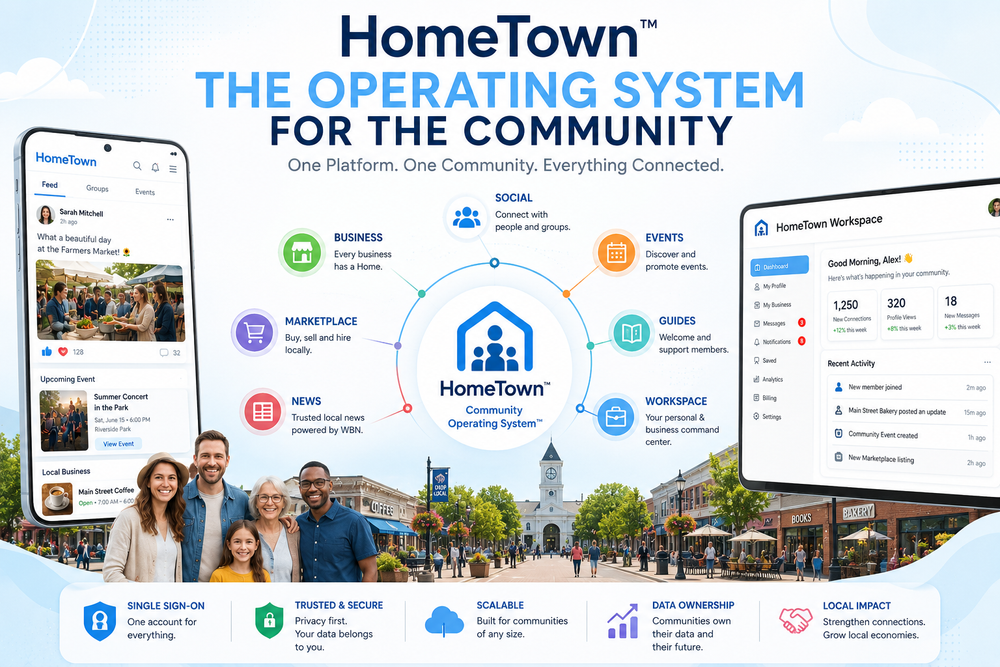
HomeTown is building the Community Operating System — a connected set of applications through which people, businesses, organizations, and publishers run the parts of their lives that happen locally. Not a single app, but an ecosystem: HomeTown Social for community and connection, HomeTown Workspace for personal and business organization, WBN News for local journalism, and a growing set of applications underneath a shared identity, a shared data model, and a shared principle — that local ownership beats platform dependence.
Tonight's build session took this from architecture diagram to working software: identity switching between personal and business presence, interest-based Groups with real governance, a Marketplace, and the first slice of Workspace. Every one of these pieces was built on the same foundation that made the original vision work — real local trust, owned infrastructure, and a platform built specifically for community, not repurposed from one built for something else.
This document lays out the complete vision: what each application does, how they connect, how the business works, and the path from a working platform in Delta, British Columbia, to infrastructure that any town, any publisher, or any organization can own for themselves.
In one sentence
HomeTown is the digital infrastructure for local life — owned locally, connected globally, and never at the mercy of a platform someone else controls.
01 · The Core Vision
Not another social network.
Facebook connects people. Nextdoor connects neighbours. HomeTown connects everything a community actually runs on.
Every existing social platform optimizes for the same thing: attention, held as long as possible, sold to advertisers. That model rewards outrage and virality over usefulness, and it treats every community — a small town, a professional group, a local newsroom — as raw material for the same undifferentiated feed.
HomeTown starts from a different question: what does a community actually need to function? Not a feed. A place to find each other, a place to buy and sell, a place to read real local news, a place for businesses and organizations to have a genuine presence, and a place for the people who make a neighbourhood work — the connectors, the volunteers, the guides — to be recognized for it.
Every application shares one identity layer. A member's presence, reputation, and relationships travel with them everywhere.
The platform connects people, communities, businesses, organizations, publishers, governments, schools, sports clubs, events, marketplace activity, and artificial intelligence into one coherent system — not by forcing everything into one feed, but by giving every part of local life its own well-built application, sharing one identity and one connected data model underneath.
03 · HomeTown Workspace™
The Personal & Business Operating System.
The place a member's day starts — not a bookmark manager with widgets.
Workspace is where members organize the parts of their life that aren't inherently social: saved links, notes, tasks, projects, calendar, files, and scheduled posts across their public channels. The guiding principle is that everything in Workspace is an object — a link, a note, a task — capable of connecting to any other object in the HomeTown ecosystem. A saved link about a restaurant can become that restaurant's Business Home. A note becomes a Group announcement. A task connects to a Project connects to a Community initiative.
HOME BASE
Dashboard
Configurable, drag-and-drop command center.
CAPTURE
Library & Links
Every saved resource, one system — not just bookmarks.
THINKING
Notes
Connected to the objects they're about.
DOING
Projects & Tasks
Work that can involve a Group, a Business Home, or just yourself.
TIME
Calendar
Personal, and connected to Community and Group events.
REACH
Scheduled Posts
Write once, publish to HomeTown Social and beyond, on your schedule.
ASSIST
AI
Understands relationships across your Workspace, not just individual files.
PEOPLE
Contacts & Files
Everything connected to the people and documents around it.
Universal Save
One save, many destinations. A member saves a webpage once, and can also add it to a Project, a Group, a Business Home, or Favorites — without saving it five separate times in five separate tools.
04 · WBN News™
The News Operating System.
Local journalism, built on infrastructure the community actually owns.
WBN News exists because local journalism, done well, earns real trust — and real trust deserves real infrastructure. Delta City News proved that a local newsroom could build a genuinely engaged readership. WBN News is that proof, built out into a complete newsroom platform: story assignment through publication, distribution, and reader analytics, owned end to end rather than borrowed from someone else's feed.
The newsroom, end to end
| Stage | What happens |
|---|---|
| Discovery & Assignment Desk | Story ideas surface from Community Intelligence and are assigned to contributors. |
| Candidate Queue | Draft stories move through review before publication. |
| Editorial | Human editors — not just automation — shape and approve every story. |
| Publishing & Distribution | A story publishes to WBN and appears natively inside HomeTown Social's local feed — not as a link-out. |
| Analytics & AI Agents | Real readership data, and AI assistance for research, drafting, and story discovery. |
| Publisher Network | Other independent local publishers can run their own WBN instance under the same infrastructure. |
This is the deepest point of connection between HomeTown Social and WBN News: a Publisher Home posts real journalism directly into the community it covers, with full discussion and reaction — genuinely native content, not a sidebar widget pointing elsewhere.
05 · HomeTown Business™
Every business gets a Home.
Not a directory listing. A real, owned presence.
Traditional local business directories are static: a name, an address, maybe a phone number, controlled by whoever runs the directory. HomeTown Business replaces that model entirely. Every business creates its own Business Home — the same real-page, real-identity system used everywhere else in the platform, extended with the tools a business actually needs.
NewsEventsProductsServicesFollowers
GroupsJobsOffersAdvertisingAnalytics
MessagingReviewsPhotosVideosArticles
AI AssistantSponsors
Because a Business Home is a first-class object in the same graph as everything else, it inherits real advantages a static directory listing never could: it can post into the community feed, follow and be followed, connect to Groups its owner runs, publish its own news, and — critically — be found through the same relationship-aware search used across the whole platform.
06 · HomeTown Groups™
Where interest becomes community.
Communities are places. Groups are everything else people care about.
Not everything that connects people is geographic. A parents' group, a hiking club, a professional network, a church congregation — these gather around shared interest, not shared postal code. Groups exist as their own real application: their own page, their own Discussions feed, their own membership, and real governance.
Governance, taken seriously
A Group is only as trustworthy as the structure that runs it. HomeTown Groups implements a genuine leadership hierarchy — Founder, Co-Founder, Moderator, Member — with real, distinct permissions at each level: who can approve new members, who can pause a disruptive one, who can remove someone outright, and who alone can transfer ownership or delete the Group entirely. This isn't cosmetic. It's the difference between a Group that can actually be trusted to self-govern and one that quietly depends on a single person never leaving.
ProfessionalNeighbourhoodSportsChurches
SchoolsBusinessesNon-profitsPublic
UnlistedPrivate, Invitation Only
07 · HomeTown Guides™
The human layer.
No algorithm replaces the person who actually welcomes you to a new place.
Every platform eventually has to answer the same question: how does a new member find their footing? HomeTown's answer is not another onboarding wizard. It's a real person.
| Role | What they do |
|---|---|
| Referral Partner | Invited someone in — the first connection, tracked and credited. |
| HomeTown Guide | Welcomes new members, answers questions, helps people find their way. |
| Mentor | Deeper, ongoing support for a specific member's growth on the platform. |
| Community Guide | Ambassador for a specific geographic Community. |
| Business Guide | Helps local businesses actually get value from their Business Home. |
| Regional Guide | Coordinates Community Guides across a wider region. |
Why this matters
A platform that scales through algorithms alone scales impersonally. A platform that scales through Guides scales the way real communities actually grow — one welcome at a time, by someone who lives there.
08 · HomeTown Marketplace™
Community Commerce.
Beyond classifieds — the full range of how neighbours already exchange value.
The platform's first release treats buying and selling the way Kijiji or Facebook Marketplace already do: a member lists an item, a buyer messages them, and the two of them close the deal directly. HomeTown never touches the money — it just makes the connection easy and the seller trustworthy, because they're a real member of the community, not an anonymous account.
The long-term vision extends well past individual listings, into the full range of how value already moves through a community:
BookingsEvent TicketsServicesProducts
CouponsDonationsFundraisingVolunteer Opportunities
Local Shopping
Every listing, booking, or fundraiser is, structurally, the same kind of object as everything else in the platform — connected to the member who posted it, the Community it belongs to, and, where relevant, the Business Home or Group behind it.
09 · HomeTown AI™
Woven in, not bolted on.
Not a chatbot in the corner. A layer running through every application.
The wrong way to add AI to a platform is a single assistant icon that answers generic questions with no real knowledge of the platform underneath it. HomeTown's approach is the opposite: AI capability distributed into the specific job each application already does.
AI Search
Understands intent and relationships, not just keywords.
AI Moderation
A first pass on safety, backed by real human review.
AI Discovery
Surfaces the Group, Home, or listing a member didn't know to search for.
AI Publishing
Supports WBN journalists in research and drafting — never replaces editorial judgment.
AI Summaries
A reading list, a discussion thread, a day's local news — condensed on request.
AI Business Assistant
Helps a Business Home owner actually use what they've built.
AI Community Assistant
"Ask Delta" — grounded in real local knowledge, not the open internet.
AI Workspace Assistant
"Find the article I saved two months ago about Vancouver real estate."
10 · Identity
One person, unlimited belonging.
A member is never forced to be only one thing.
Identity flows downward. Everything a member builds — Homes, Groups, Workspace objects — follows them everywhere.
My Homes™ is the concrete expression of this principle: a member's Personal Home is simply their existing profile — never duplicated, never a separate account. Business and Networking Homes are additional identities they can create and switch between with one click, each with its own name, its own image, its own audience — without ever needing a second login or a second password.
11 · Community Model
The geography of belonging.
Communities are hierarchical. Groups are not — and that distinction is deliberate.
A member can belong to Vancouver, British Columbia, Canada, and Global all at once — not as redundant memberships, but as the same thread followed at different zoom levels. Following your city naturally connects to following your province and country; the hierarchy carries real information, not just organizational tidiness.
Community — the geographic backbone. Business, Organization, Group, and Home connect at any level of this hierarchy.
Groups sit outside this ladder entirely, because interest doesn't nest the way geography does. Photography and hiking aren't subcategories of each other — they're simply separate. Keeping Communities and Groups as genuinely different structures, rather than forcing everything into one taxonomy, is what keeps both legible as the platform grows.
12 · Universal Object Model
Everything relates to everything.
Facebook built the Social Graph. Google built the Knowledge Graph. HomeTown builds the Community Graph™.
Every meaningful thing in the platform — a Person, a Business, an Event, a Link, a Document, a Group, a Task, a News Story, an Organization — is modeled as an object capable of relating to any other object. A restaurant's website, saved once as a Link, can later become that restaurant's Business Home, an Event venue, a Group's regular meeting place, a HomeTown Guide's recommendation, and a News Story reference — the same underlying object, connected outward in as many directions as it's genuinely relevant.
The connections between things become as valuable as the things themselves.
This is the architectural bet the whole ecosystem rests on: that a platform built around real relationships between real objects will always out-compete one built around a single undifferentiated feed, because it can answer questions a feed never could — not just "what's happening," but "how does this connect to what I already care about."
13 · Universal Search
Finding, not just searching.
Search that understands relationships, not just keywords.
Because every object in the platform is connected to others, search can do more than match text — it can reason about relevance the way a person would. "Find a plumber in Delta someone in my Group has actually used" isn't a stretch feature; it's the natural consequence of a relationship-aware data model, surfaced through natural language and semantic search rather than a rigid filter form.
Universal Search, AI Search, and Discovery are three faces of the same underlying capability: helping a member find the right person, place, business, or piece of information — not just the one that happens to match their exact words.
14 · Long-Term Architecture
Built to be licensed, not just scaled.
The difference between a platform and infrastructure is who gets to own a piece of it.
HomeTown's architecture is cloud-based, API-first, and modular — a genuine developer platform in waiting, with the scaffolding for a future SDK, extensions, and a developer marketplace. But the architectural decision that matters most for the long-term vision is multi-tenancy done through licensing, not centralization.
The 100,000-town model
HomeTown is not designed to be one giant platform that every town's data funnels into. It's designed the way the internet itself works: locally owned and operated instances — one per licensed market — connected by shared architecture and, where relevant, shared visibility across the network. A licensed operator in Surrey owns Surrey's instance. A licensed operator in a different province owns theirs. Each is a real, independently operating business, running on infrastructure they didn't have to build from scratch.
This solves two problems simultaneously: it keeps any single deployment's data and storage needs modest and manageable rather than concentrated into one unmanageable database, and it means local ownership — the entire founding principle of this company — is architectural, not just marketing language.
| Layer | Approach |
|---|---|
| Security & Permissions | Row-level access control, tiered roles at every application level. |
| Scalability | Per-market instances; no single point of data concentration. |
| Developer Platform | API-first today; SDK, extensions, and plugin marketplace as the network matures. |
15 · Revenue
How this becomes a business.
Many small, honest revenue lines — not one fragile one.
AdvertisingSubscriptionsBusiness ServicesEnterprise
MarketplaceLicensingSponsorsEvents
CoursesDeveloper MarketplacePremium CommunitiesPremium AI
Licensing is the revenue line most directly tied to the long-term vision: a media license for a market — Vancouver, Delta, a health-focused community, an ethics organization — comes with the full HomeTown Social and WBN News stack, training, and ongoing support, sold to an operator who already has a reason to want that visibility, whether they're a local publisher, a real estate professional, or a community-minded entrepreneur. The platform's own economics and its licensees' economics grow together, rather than the platform competing with the businesses running on it.
16 · Roadmap
From one town to every town.
01
Prove It In One Market
HomeTown Social and WBN News fully live in Delta, BC. Homes, Groups, Marketplace, and the first slice of Workspace shipped and tested with real members.
02
Expand The Ecosystem
Workspace matures into a genuine daily tool. AI capability spreads through Search, Discovery, and Community Assistants. Business Homes reach feature parity with the original vision.
03
License The First New Markets
A second and third town, run by licensed operators on the proven stack. The multi-tenant licensing model moves from architecture to operating reality.
04
Open The Network
Developer SDK, plugin marketplace, and a genuine publisher network for independent local newsrooms who want the same platform independence HomeTown itself was built to guarantee.
—
Long-Term Vision
The digital infrastructure layer for local life, everywhere it's wanted — a hundred thousand towns, each locally owned, each connected to the same underlying Community Graph.
17 · Closing
This was never really about software.
It's about the person who runs the local news site in a town of forty thousand people, and built something real enough that the whole town started paying attention.
It's about the neighbour who becomes a Guide, and welcomes the next new family the way someone once welcomed theirs. The volunteer whose fundraiser actually reaches the people two streets over. The small business owner whose storefront is finally a real page, not a line in a directory nobody opens. The student in a Group of people who share their exact, specific, un-Googleable interest.
Every one of the applications in this document exists to make one thing true, in as many towns as will have it: that the place you actually live has a real digital home — one that belongs to the people who live there, not to a platform that could change the rules tomorrow.
Communities. People. Neighbourhoods. Businesses. Local economies. Families. Volunteers. Publishers. Schools. Cities. This is the infrastructure for all of it.
— HomeTown™
The Community Operating System.
Where a place becomes a platform, run by the people who actually live there.
HomeTown Social is the flagship application — the neighbourhood layer. Every member has a Profile, belongs to a Community defined by real geography, and can create Homes: Personal, Business, or Networking identities they can switch between without a second login. One account, many homes — a member is never forced to represent only themselves.
What lives here
Profiles & Homes
Personal, Business, and Networking presence, switchable in one click.
Communities
Global down to neighbourhood — real places, not algorithmic feeds.
Groups
What you're into, independent of where you live.
Messaging & Discovery
Direct conversation, and a real way to find people, Homes, and Groups.
Business Homes
Every business gets a real page — not a directory listing.
News & Community Pulse
Real local journalism, native to the feed, not a link out.
Emergency Alerts
Time-sensitive local information, delivered where people already are.
Moderation & Governance
Tiered roles — Founder, Co-Founder, Moderator — real accountability at every level.
Community Intelligence reframes what a "feed" is for. Instead of a generic stream of whatever is loudest, a member's home view surfaces what's actually relevant to where they live: today's events, road closures, missing pets, weather, and what's genuinely trending in their own community — not the whole internet's.