
WBN News Corp Inc.™
Editorial Standards™
v1.0
Effective: June 27, 2026
Last Updated: June 27, 2026
Applies to all WBN News Corp editorial output — across every platform, edition, product, and contributor relationship, globally.
WBN Editorial Standards™ v1.0:
Truth · Independence · Accountability · Transparency · Fairness
·
Applies to every WBN platform, edition, and contributor globally
·
Aligned with WBN Ethics & Integrity Charter and Responsible AI Policy
·
Editorial concerns: editorial@wbnn.news
Editorial Statement · WBN News Corp Inc.™
"Our editorial standards are not a ceiling on what we aspire to. They are a floor below which we will not fall."
These standards govern every piece of journalism WBN News Corp produces — every story, every summary, every intelligence output, every headline. They apply to our own staff, to every contributor who publishes under the WBN name, and to every AI system that assists in the production of our content. They are not aspirational. They are operational. And they are binding.
Contents
14 sections · Click to navigate
1Our Editorial Mission
2Truth, Accuracy & Verification
3Fairness, Impartiality & Balance
4Editorial Independence
5Sources, Attribution & Transparency
6Corrections & Editorial Accountability
7News, Opinion & Sponsored Content
8Conflicts of Interest
9Diversity, Respect & Sensitive Reporting
10Privacy in Journalism
11Public Interest Journalism
12AI-Assisted Journalism & Human Oversight
13Images, Multimedia & Visual Standards
14Governance, Learning & Contact
1
Our Editorial Mission
WBN News Corp exists to inform. Not to entertain at the expense of accuracy. Not to engage at the expense of truth. Not to grow an audience at the expense of the public good. To inform — accurately, fairly, independently, and with a clarity that gives people the understanding they need to make better decisions about their businesses, their communities, and their world.
We operate a global AI-enabled media and intelligence network. That means our editorial output reaches further, faster, and in more formats than traditional journalism — and that the responsibility that comes with that reach is correspondingly greater. We take it seriously.
🔍
Inform
We give our audiences the facts they need, verified to the highest standard we can achieve, delivered clearly and without distortion.
⚖️
Explain
We do not stop at reporting what happened. We help our audiences understand why it matters, what drives it, and what it may mean.
🔦
Scrutinise
We hold powerful institutions and individuals to account. Scrutiny in the public interest is not optional journalism — it is the core of it.
🌐
Connect
We connect our audiences to the stories, signals, and intelligence that matter to them — globally and locally, in real time and in depth.
🛡️
Protect
We protect the integrity of our editorial process from commercial, political, and personal influence. Independence is not a luxury. It is the product.
🤝
Trust
We earn the trust of our audiences every day, through every story. Trust is not declared. It is demonstrated, consistently, over time.
These standards are how that mission is put into practice. Every journalist, editor, contributor, and AI system working within WBN's editorial environment is bound by them.
2
Truth, Accuracy & Verification
Accuracy is the most fundamental obligation of journalism. Everything else — fairness, independence, transparency — depends on it. A story that is fast but wrong is not a competitive advantage. It is a failure of our core function and a breach of the trust our audiences place in us.
The Standard We Apply
Every factual claim published by WBN must be accurate to the best of our knowledge at the time of publication. That means verified against reliable sources before publication — not assumed, not inferred without evidence, and not accepted on the basis of a single unverified account. Where a claim cannot be verified to the standard required, it is not published as fact. It may be published as an allegation, a claim, or a developing situation — but only when that characterisation is made explicit to the reader.
Verification Requirements
- Multiple sources. Significant factual claims require verification from more than one independent source. A single source — however credible — is not sufficient for claims that carry significant consequence for individuals, organisations, or public understanding.
- Primary sources preferred. Original documents, official records, direct testimony, and on-the-record statements from authoritative sources are preferred over secondary reporting. When we rely on another news organisation's reporting, we say so and attribute it clearly.
- Right of reply. Any individual or organisation that is the subject of significant criticism, adverse findings, or serious allegations in our reporting is contacted for a response before publication, given reasonable time to reply, and has their response reflected in the published record — whether they respond or decline.
- Developing stories. When a story is still developing and full verification is not yet possible, we say so clearly. We report what is confirmed, distinguish it from what is alleged or unconfirmed, and update our coverage as the facts become clearer.
- Data and statistics. Numerical claims — statistics, financial figures, poll results, and quantitative data — are verified against primary sources. We identify the source of all data we publish, note its methodology where relevant, and are transparent about its limitations.
Speed Is Never an Excuse
WBN operates in a real-time media environment where the pressure to publish quickly is constant. Our position is unambiguous: we will not sacrifice accuracy for speed. Being second with a correct story is always preferable to being first with a wrong one. Where time pressure is genuine, we publish what is verified and label clearly what remains unconfirmed — rather than guessing or filling gaps with speculation presented as fact.
3
Fairness, Impartiality & Balance
Fairness in journalism means applying the same rigour, the same scrutiny, and the same standards to all parties in a story — regardless of their political affiliation, commercial significance, or relationship with WBN. It means giving every significant perspective a genuine hearing. And it means making judgments based on evidence rather than preference, ideology, or audience expectation.
Impartiality in News Reporting
WBN's news reporting does not take sides on matters of legitimate political, social, or policy debate. We report what is known, what is credibly claimed, and where genuine disagreement exists — and we are honest about the distinction between these. Our journalists' personal views belong to them, not to their reporting, and we have editorial processes in place to ensure that personal opinion does not contaminate factual news coverage.
Balance That Is Genuine, Not Mechanical
Balance does not mean treating every claim as equally valid regardless of the evidence behind it. Where scientific, legal, or factual consensus exists, we report it as such. We do not manufacture false controversy by presenting fringe positions as equivalent to established fact in the name of appearing balanced. True impartiality means following the evidence — not creating artificial symmetry between positions that are not symmetrically supported.
Consistency of Standards
We apply the same editorial standards to all people and organisations regardless of their power, prominence, or relationship with WBN. A government, a corporation, a public figure, and a private individual all receive the same standard of fairness. We do not apply tougher scrutiny to those we disagree with or easier treatment to those we find sympathetic.
Global Fairness
WBN serves a global audience. Our commitment to fairness extends across every jurisdiction, culture, and community we cover. We do not apply one standard to stories in our home market and a different standard to stories elsewhere. We are alert to the cultural assumptions embedded in our own perspectives and work actively to counter them.
4
Editorial Independence
The value of WBN's journalism depends entirely on its independence. Reporting that is shaped by commercial interest, political pressure, or personal relationships is not journalism — it is advocacy wearing journalism's clothing. We will not produce it.
The Separation Principle
Editorial decisions at WBN are made by editors and journalists on the basis of newsworthiness, public interest, accuracy, and ethical soundness. Advertisers, sponsors, investors, and commercial partners have no role in editorial decisions. Political parties and government bodies have no role in editorial decisions. This separation is absolute. Any attempt to influence WBN's editorial content through commercial, financial, or political pressure will be refused — and where appropriate, reported.
Commercial Relationships Do Not Buy Coverage
Advertising and sponsorship relationships do not entitle any organisation to positive editorial coverage, protection from critical reporting, or advance notice of stories that concern them. Nor do they entitle any organisation to suppress coverage they find unfavourable. WBN's editorial decisions about any organisation are made on the same basis as decisions about any other — the editorial merit of the story and its value to our audiences.
Editorial Authority
WBN's editorial leadership holds final authority over all content published under the WBN name. Business decisions — including decisions about advertising, technology partnerships, investment, or product strategy — do not override editorial judgment on matters of content, accuracy, or ethics. Where commercial and editorial interests appear to conflict, the resolution always favours editorial integrity.
Political Independence
WBN does not endorse political candidates, parties, or ideological movements. Our political reporting is guided by the facts and by genuine public interest. We are sceptical of all sources of political power — including governments of every stripe — and we apply that scepticism consistently. We do not grant favourable treatment to political figures or institutions in exchange for access.
5
Sources, Attribution & Transparency
Sources are the foundation of journalism. How we find them, assess them, use their information, and represent them to our audiences defines the quality and integrity of everything we publish. WBN's approach to sources is built on transparency — we tell our audiences where information comes from, how it was obtained, and where its limitations lie.
On-the-Record Standards
WBN strongly prefers on-the-record sourcing — information provided by identifiable sources who are willing to be named in our reporting. On-the-record reporting is the most transparent form of journalism and the easiest for our audiences to evaluate. We pursue on-the-record accounts actively and accept anonymous sourcing only when the conditions described below are met.
Anonymous & Confidential Sources
Sometimes the most important information comes from people who face genuine personal or professional risk if identified. WBN uses anonymous sources when the following conditions are all satisfied:
- The information is of genuine public interest and cannot be obtained through any other means.
- The source's credibility has been independently assessed and their account corroborated where possible.
- The source understands the terms under which their information will be used and has consented to them.
- A senior editor has reviewed and approved the use of anonymous sourcing for this story.
When we use anonymous sources, we tell our readers as much as we can about who the source is — their role, their relationship to the events described, and why they cannot be named — without identifying them. Anonymous sourcing is never used to enable personal attacks or unsubstantiated allegations against individuals.
Source Protection
WBN's commitment to protecting confidential sources is absolute. We do not reveal the identity of a source who has been promised confidentiality, except where ordered to do so by a court after all available legal remedies have been exhausted. We take active steps to protect source identities — including through secure communications, minimisation of identifying records, and careful handling of digital materials. We provide legal support to journalists facing compelled disclosure.
Attribution Practices
- Direct quotes reflect exactly what a source said. We do not alter direct quotes for grammar, preference, or effect.
- Paraphrasing accurately reflects the substance and meaning of what was said, without distortion.
- Secondary reporting — information drawn from another news organisation's work — is clearly attributed to that organisation. We do not present others' reporting as our own.
- Documents and data are identified by type and source. We do not misrepresent the nature, provenance, or status of documents we publish or cite.
6
Corrections & Editorial Accountability
Every news organisation makes mistakes. The measure of editorial integrity is not whether errors occur — they will — but how an organisation responds when they do. WBN corrects errors promptly, visibly, and without the kind of defensive language designed to minimise the perception of failure rather than serve accuracy.
Our Corrections Standard
- Promptness. When an error is confirmed, we publish a correction as quickly as possible — typically within 24 hours. We do not delay corrections to manage news cycles or protect reputations, including our own.
- Clarity. Corrections state plainly what was wrong, what the correct information is, and when the correction was made. We do not use vague language that obscures the nature or significance of the error.
- Prominence. The prominence of a correction reflects the prominence of the original error. A significant error in a major story is not corrected with a minor footnote. Readers who saw the original error should, wherever possible, see the correction.
- Archival integrity. Where a published article contained a material error, that article is updated with a clear correction notice including the date of the update. We do not silently alter published content. We do not delete accurate reporting because it has become inconvenient.
- AI error disclosure. Where an error originates in AI-generated or AI-assisted content, this is disclosed in the correction. AI errors are treated with the same seriousness and the same correction standard as errors produced by human journalists.
Complaints & Responses
WBN takes complaints about its journalism seriously and investigates all good-faith complaints promptly. Where a complaint identifies a genuine error or failure of our standards, we act on it and reflect that in our published record. We respond to complainants directly and do not ignore concerns because they are uncomfortable. Complaints may be directed to editorial@wbnn.news.
External Accountability
WBN welcomes scrutiny from media critics, journalism standards bodies, and the public. We engage genuinely with external review processes and take their findings seriously. Where an external review identifies a failure of our standards, we report publicly on what we have done in response.
7
News, Opinion & Sponsored Content
Trust depends on clarity. Readers must always know whether what they are reading is independent reporting, editorial opinion, or commercially funded content. WBN maintains clear, consistent distinctions between these categories and applies prominent labelling so that no reader can be misled about what they are reading.
News Reporting
News reporting at WBN is factual, impartial, and free from the personal opinions of those who produce it. News journalists do not advocate for positions or express personal views in their reporting. Their job is to establish and communicate what is true, what is credibly alleged, and where genuine uncertainty exists.
Opinion & Commentary
WBN publishes opinion, analysis, and commentary that is clearly labelled as such. Opinion writers — whether staff or contributors — speak for themselves and not for WBN as an institution. The presence of an opinion on WBN's platforms does not imply WBN's endorsement of that view. We curate opinion with a deliberate commitment to diversity of perspective. We do not publish commentary solely because it reflects a view WBN or its leadership finds convenient.
Sponsored Content
WBN may publish content that is funded by commercial sponsors. When it does, that content is clearly and unambiguously identified as sponsored at the point of first encounter — not buried in small print, not disclosed only on a separate page, and not labelled in a way designed to obscure rather than reveal the commercial relationship.
Sponsored content published on WBN platforms must meet our content standards for accuracy and decency. We do not publish sponsored content that is false, misleading, or contrary to the public interest, regardless of the commercial value of the relationship involved. The production of sponsored content is handled separately from our news and editorial teams to preserve the integrity of both.
The rule is simple: If a reader could reasonably mistake commercial content for independent journalism, we have not labelled it clearly enough. We apply this test to every piece of sponsored or commercially associated content we publish.
8
Conflicts of Interest
A conflict of interest exists when a personal, financial, or institutional relationship has the potential — actual or perceived — to compromise editorial judgment. WBN's approach is to identify and manage conflicts proactively, disclose them where they are relevant to our coverage, and remove them where disclosure alone is insufficient.
- Financial interests. WBN journalists and editorial contributors do not hold financial interests in companies or sectors they cover. Where such an interest exists or arises, the journalist steps away from that coverage and the interest is disclosed.
- Personal relationships. Journalists do not make editorial decisions about individuals with whom they have a significant personal relationship — whether romantic, familial, or a close friendship. The relevant coverage is assigned to another journalist.
- Outside activities. Editorial staff disclose paid outside work, advisory roles, board memberships, and public advocacy positions that could create a conflict with their WBN responsibilities. Activities that may compromise independence require approval from editorial leadership.
- Gifts and hospitality. WBN editorial staff do not accept gifts, payments, or hospitality from sources, subjects of coverage, or commercial partners that could create an obligation or the perception of one. Modest hospitality in a standard professional context may be accepted at senior editorial discretion.
- Institutional conflicts. WBN discloses significant commercial relationships — major advertisers, sponsors, investors, technology partners — where those relationships are editorially relevant to a story we are covering.
When in doubt, disclose. WBN's default position on conflicts of interest is that transparency is almost always better than silence. If a conflict is minor but visible, acknowledging it and explaining how it was managed builds more trust than pretending it does not exist.
9
Diversity, Respect & Sensitive Reporting
WBN is a global media organisation. Our editorial standards must reflect the full breadth of the world we cover and the audiences we serve. That means approaching every story, every community, and every individual with the same respect, the same rigour, and the same fairness — regardless of geography, culture, identity, or prominence.
Diversity of Voices
WBN actively seeks out a diversity of authoritative voices in its reporting — across geography, gender, background, expertise, and experience. We are alert to the tendency of media organisations to return repeatedly to the same narrow pool of sources, and we work deliberately to counter it. A broader range of perspectives in our reporting produces better journalism and better serves our global audience.
Language and Representation
The language we use in our reporting shapes how people understand the subjects we cover. WBN uses language that is accurate, fair, and respectful — without euphemism that obscures truth and without language that demeans, stereotypes, or dehumanises. We use the terminology that individuals and communities use to describe themselves where it is accurate and editorially appropriate to do so.
Sensitive Topics
WBN applies heightened care to reporting on topics that involve vulnerability, trauma, or personal harm — including mental health, suicide, addiction, abuse, crime victimisation, and displacement. We follow established responsible reporting guidelines for these areas, apply senior editorial oversight, and always consider whether publication serves a genuine public interest proportionate to the potential harm.
What We Will Not Publish
WBN will not publish content that incites hatred, discrimination, or violence against any individual or group on the basis of race, religion, ethnicity, gender, sexual orientation, disability, or any other protected characteristic. This prohibition applies to original WBN editorial content, to submitted and contributed content, and to AI-assisted content. It is not subject to exception on grounds of newsworthiness or commercial value.
10
Privacy in Journalism
The right to privacy is fundamental. Journalism sometimes requires reporting on matters that individuals would prefer remained private — but the necessity of a story does not eliminate the obligation to handle personal information with care, proportionality, and genuine respect for the people involved.
The Public Interest Test
Before publishing information that engages an individual's privacy, WBN applies a genuine public interest test. The question is not whether information is interesting to the public — but whether there is a legitimate and proportionate public interest in its disclosure. Curiosity, entertainment value, and commercial appeal are not sufficient justifications for privacy intrusion. Accountability for the exercise of public power, genuine matters of public safety, and the exposure of significant wrongdoing may be.
Public Figures and Private Individuals
Public figures — politicians, executives, celebrities, and others who have voluntarily entered public life — accept scrutiny of their public roles and the exercise of their public responsibilities. They retain a private sphere, and intrusion into that sphere requires a clear public interest justification. Private individuals who find themselves involuntarily connected to a news story are entitled to a higher standard of protection and receive it.
Children
WBN applies its highest standard of care to content involving children. We do not publish information that identifies, endangers, or exploits minors in any circumstance — including when parents or guardians have consented to publication. The welfare of a child takes precedence over editorial considerations in every case.
11
Public Interest Journalism
WBN is committed to journalism that serves the public interest — not just the interests of its audiences as consumers, but their broader interests as citizens, professionals, and members of communities. Public interest journalism sometimes requires resources, time, and courage. It is consistently worth the investment.
What Public Interest Journalism Looks Like at WBN
- Accountability journalism that scrutinises the exercise of power by governments, corporations, financial institutions, and other significant organisations.
- Investigative reporting that uncovers wrongdoing, corruption, or systemic failure that would otherwise remain hidden.
- Explanatory journalism that gives audiences the context to understand complex issues affecting their businesses, their communities, and their world.
- Intelligence and data journalism that uses WBN's analytical capabilities to identify patterns, trends, and signals that are not visible to individual observers.
- Coverage of underreported stories — communities, markets, and issues that receive insufficient attention from mainstream media.
Justifying Difficult Journalism
Some of WBN's most important journalism will be uncomfortable — for the subjects of our reporting, for our commercial partners, and sometimes for our audiences. We publish difficult journalism when it serves a genuine public interest that is proportionate to the discomfort it causes. The editorial leadership of WBN stands behind this journalism and supports the journalists who produce it.
12
AI-Assisted Journalism & Human Oversight
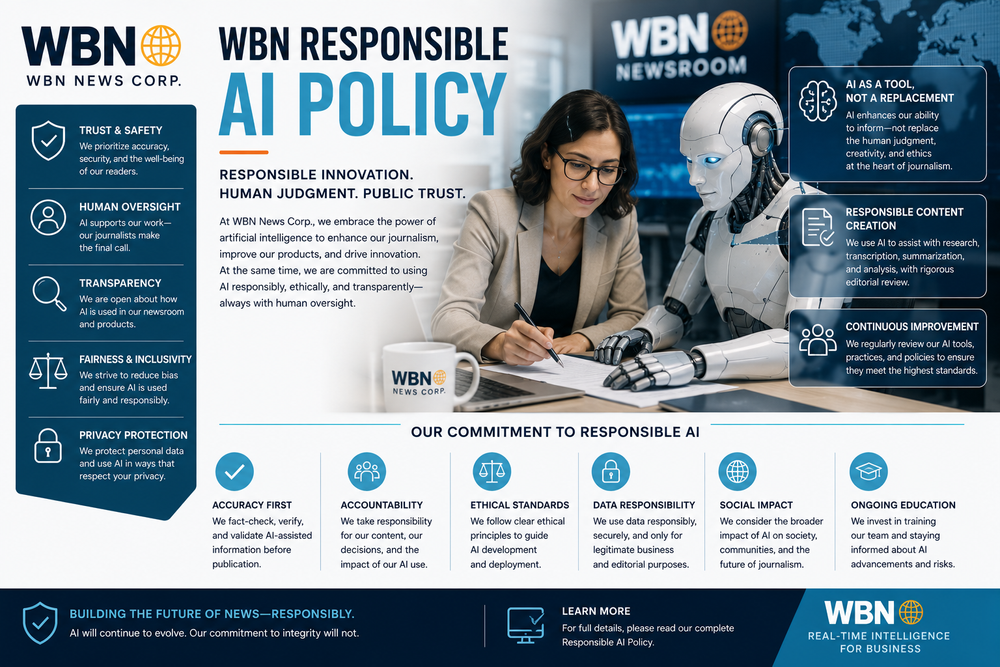
WBN uses artificial intelligence to support editorial workflows across its platforms. AI assists our journalists — it does not replace them. The judgment, the accountability, the editorial decision-making, and the final responsibility for every published piece of content remain with a human being.
How AI Supports Our Journalism
🔎
Research
AI assists journalists in locating sources, identifying relevant documents, and surfacing background information. Journalists verify all AI-surfaced research before use.
✍️
Drafting
AI may produce first-draft summaries of documents, data sets, or briefing materials. Human editors review, revise, and are responsible for all published output.
📡
Signal Processing
AI processes large volumes of business, economic, and civic signals to identify what is significant. Human analysts determine editorial relevance and framing.
🌍
Translation
AI assists in translating content for WBN's global editions. Human review ensures accuracy, cultural appropriateness, and editorial consistency.
✅
Fact Assistance
AI may flag potential factual inconsistencies or assist in cross-referencing claims. Journalists verify all flagged items independently before reaching editorial conclusions.
📊
Data Analysis
AI supports analysis of large datasets for data-driven journalism. Methodology is reviewed by human analysts and documented for transparency.
What AI Does Not Do
- AI does not make editorial decisions about what to cover, how to frame a story, or what conclusions to draw.
- AI does not publish content to WBN platforms without human review and approval.
- AI does not determine whether a story meets WBN's ethical and editorial standards — that judgment belongs to a human editor.
- AI does not fabricate quotes, sources, or factual claims. Any AI output containing fabricated information is an error and is treated as such under our corrections standard.
Disclosure of AI in Editorial Content
When AI has contributed materially to the creation or editing of published content, that contribution is disclosed to our readers. We do not present AI-assisted content as purely human-authored work. The disclosure is clear, placed prominently, and written in plain language. The standard for what constitutes material AI contribution is applied consistently across all WBN platforms and products.
The editorial standard does not change based on who — or what — produced the content. AI-assisted content is held to exactly the same accuracy, fairness, independence, and ethical standards as content produced entirely by human journalists. The tool used to create a piece of journalism does not lower the bar for what it must achieve.
13
Images, Multimedia & Visual Standards
Visual content carries the same editorial responsibilities as written content — and in some respects greater ones, because images communicate immediately and powerfully in ways that prose does not. WBN applies the same standards of accuracy, fairness, and ethical judgment to all visual content it publishes.
Accuracy in Visual Content
- Images must accurately represent what they depict. A photograph must not be presented in a context that misrepresents the event, location, or time it shows. Captions must be accurate and verified.
- Images must not be materially altered. Cropping, colour correction, and standard technical adjustments are acceptable. Alterations that change the factual content of an image — adding, removing, or significantly changing what the image shows — are not permitted in news content.
- File photographs must be clearly identified as archival when used in a news context where timeliness is relevant. We do not present old images as current without clear disclosure.
AI-Generated Images
WBN does not publish AI-generated images in news contexts without clear disclosure that the image is AI-generated. We do not use AI-generated images of real people in news reporting. In editorial and commercial contexts where AI-generated images are used, they are labelled clearly and distinguishable from photographic content.
Dignity and Sensitivity
We do not publish images or video that gratuitously depict violence, suffering, death, or degradation without a clear and proportionate public interest justification. When covering traumatic events, we consider the impact of graphic content on our audiences — including those directly affected — and apply senior editorial oversight to publication decisions. We do not publish images of children in distressing circumstances without exceptional public interest justification and senior editorial approval.
Rights and Attribution
WBN publishes only visual content for which it holds the appropriate rights or licence. All visual content is attributed to its creator or source. We respect the intellectual property rights of photographers, videographers, and other visual content creators — including through fair compensation in our commercial relationships with them.
14
Governance, Learning & Contact
Editorial Governance
These Standards are owned by WBN's editorial leadership and are reviewed and updated at least annually. They are binding on all WBN editorial staff, regular contributors, and partners operating under the WBN name. Adherence to these Standards is a condition of editorial engagement with WBN.
WBN's editorial leadership is responsible for the interpretation and application of these Standards and holds final authority over editorial decisions. Where a situation is not explicitly covered by these Standards, the editorial leadership applies the principles underlying them — accuracy, fairness, independence, transparency, and responsibility — to determine the appropriate course of action.
Continuous Learning
The media environment, the technology we use, and the ethical challenges we face are all evolving. WBN is committed to continuous learning — for our journalists, our editors, and our editorial systems. We invest in ongoing training in journalism ethics, AI literacy, data journalism, and editorial standards. We engage with the broader journalism community — including standards bodies, academic researchers, and peer organisations — to ensure our practices remain at the leading edge of the profession.
We treat errors not just as corrections to be made but as opportunities to understand how they occurred and to improve our processes. We treat our successes as opportunities to understand what we are doing well and how to do more of it.
Reader Trust
Trust is the most valuable thing WBN has — and the hardest to earn back once lost. We treat it accordingly. We do not take shortcuts with accuracy when we are under deadline pressure. We do not suppress inconvenient truths because they are commercially inconvenient. We do not tell our audiences what they want to hear instead of what is true. We believe that readers who trust us to tell them the truth, even when it is complicated or unwelcome, are the most valuable audience a news organisation can have.
Updates to These Standards
These Editorial Standards will be updated as WBN's editorial practices, technology, and global context evolve. The "Last Updated" date at the top of this document reflects the most recent revision. Previous versions are available on request. Material updates will be communicated to all editorial staff and contributors before they take effect.
Contact
📰
Editorial
Standards questions, corrections, and editorial complaints:
editorial@wbnn.news
editorial@wbnn.news
⚖️
Ethics Office
Ethics concerns and formal complaints:
ethics@wbnn.news
ethics@wbnn.news
🤖
AI Governance
Concerns about AI-assisted editorial content:
ai@wbnn.news
ai@wbnn.news
🛡️
Trust Centre
All WBN governance documents:
wbnnewscorp.com/trust-centre/
wbnnewscorp.com/trust-centre/
WBN Editorial Standards™ v1.0 | WBN Cast OS™ v0.3 | 06-27-26 PST | WBN News Corp Inc.™