
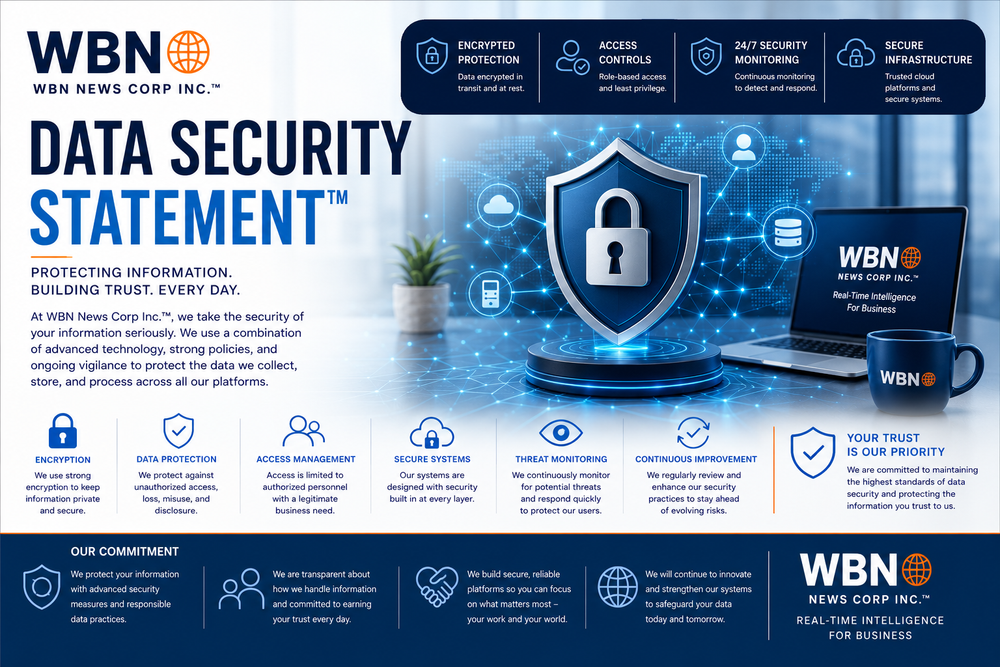
WBN News Corp Inc.™
Data Security Statement™
v1.0
Launched: June 27, 2026
Last Updated: June 28, 2026
Covers all information assets, digital systems, and data entrusted to WBN News Corp across every platform, product, and operational environment.
WBN Data Security Statement™ v1.0:
Confidentiality · Integrity · Availability — applied across every WBN system
·
Security is a continuous practice, not a periodic event
·
Report a vulnerability: security@wbnn.news
Security Commitment · WBN News Corp Inc.™
"The information people share with us in the course of using our platforms is held in trust. We take that trust seriously — technically, organisationally, and continuously."
WBN News Corp operates a global AI-enabled media and intelligence network. The information we hold — about our readers, subscribers, contributors, partners, and the editorial work we produce — carries real value and real sensitivity. This statement explains how we protect it: the principles that guide our security practice, the safeguards we apply, the responsibilities we hold, and the honest acknowledgement that security is a continuous discipline rather than a solved problem.
Contents
11 sections · Click to navigate
1
Introduction & Scope
Information security is not a feature WBN adds to its platforms. It is a fundamental condition for operating a responsible global media and intelligence organisation. When people provide us with their personal details, when subscribers access premium content, when contributors share original work, when partners exchange confidential commercial information, and when our editorial teams produce journalism that has not yet been published — all of it is held in trust. The security practices we describe in this statement are how we honour that trust.
This statement applies to all WBN News Corp information assets, digital systems, and data — across every platform, product, and operational environment we operate. It covers information held about individuals and organisations, editorial and intellectual property, operational and commercial data, AI system infrastructure, and the platforms through which our audiences access our content.
An honest starting point: No organisation — and no security statement — can guarantee complete protection against every possible threat. What we can commit to, and do commit to, is taking information security seriously, applying layered and up-to-date protective measures, responding to incidents transparently and effectively, and continuously improving our security posture as the threat landscape and our own operations evolve.
2
Our Security Principles
WBN's security practice is built on a set of foundational principles that guide every decision we make about how information is collected, stored, processed, and protected. These are not abstract values — they translate directly into how our systems are designed and how our teams operate.
🔒
Confidentiality
Information entrusted to WBN is accessible only to those with a legitimate and defined need to access it. Access is controlled, logged, and reviewed.
✅
Integrity
Information held by WBN is accurate, complete, and protected against unauthorised or accidental modification. Changes to data are controlled and verifiable.
⚡
Availability
WBN's systems and the information they contain are available to authorised users when needed — with resilience built in to minimise disruption from technical failure or external attack.
⚖️
Risk Management
We identify, assess, and manage security risks systematically — prioritising investment in protection based on the value of what we are protecting and the realistic threat landscape.
🔄
Continuous Improvement
Security threats evolve. Our security practices evolve with them. We treat security as an ongoing discipline rather than a project with a completion date.
👁️
Transparency
We are open about our security approach, honest about our limitations, and clear about what we expect from the people and organisations we work with.
3
What We Protect
WBN holds a range of different categories of information, each with its own security requirements and its own importance to the people whose information it is. Our security measures are calibrated to the sensitivity and value of what we are protecting.
- Personal information. Names, email addresses, contact details, payment information, and any other personal data provided by readers, subscribers, and users of our platforms. This information is subject to both our security standards and our Privacy Policy.
- Subscriber information. Account credentials, subscription history, usage patterns, and preference data associated with paying subscribers and registered users. This includes payment transaction records processed through our secure payment providers.
- Contributor information. Identity and contact details, submitted work, correspondence, and contractual information associated with journalists, analysts, writers, and publishing partners who contribute to WBN's platforms.
- Editorial and journalistic information. Unpublished articles, source materials, investigative research, editorial correspondence, and source-related information. The confidentiality of this category is particularly important given WBN's editorial responsibilities, including source protection obligations described in our Editorial Standards.
- Business and commercial information. Commercial agreements, financial records, partner and advertiser data, and strategic information that relates to WBN's business operations.
- Intellectual property. Proprietary software, AI model configurations, platform architecture, content libraries, databases, and the full range of digital assets described in our Copyright & IP Policy.
- AI system data. Training data, model weights, inference infrastructure, and the operational data that powers WBN's AI-enabled products. Security of AI systems is addressed specifically in Section 6.
4
Technical Safeguards
WBN implements a range of technical security controls designed to protect our systems and the information they hold. These controls are layered — meaning that multiple protective mechanisms operate simultaneously, so that no single failure creates a single point of vulnerability.
🔐
Encryption
Data in transit between users and WBN's platforms is encrypted using current industry-standard protocols. Sensitive data at rest — including personal information and credentials — is encrypted in storage. Encryption standards are reviewed and updated as the field evolves.
🪪
Authentication
Access to WBN's systems requires authentication appropriate to the sensitivity of what is being accessed. Multi-factor authentication is applied to privileged and administrative access. Password policies meet current best-practice standards.
🏗️
Secure Hosting
WBN's platforms are hosted in certified, enterprise-grade infrastructure environments that maintain their own rigorous security certifications and physical security controls.
🧱
Firewalls & Network Security
Network traffic into and out of WBN's systems is filtered through firewalls and network security controls designed to block unauthorised access while maintaining service availability for legitimate users.
🔑
Access Controls
Access to WBN's systems and data is controlled based on the principle of least privilege — individuals and systems are granted access only to what they need for their specific function. Access rights are reviewed and updated when roles change.
☁️
Cloud Security
Where WBN's operations use cloud services, those services are configured in accordance with recognised cloud security best practices — including network segmentation, identity and access management, and logging and monitoring capabilities.
📡
System Monitoring
WBN's systems are monitored on an ongoing basis for unusual activity, potential intrusion attempts, and anomalous behaviour. Monitoring alerts are reviewed and investigated by our security team.
💾
Secure Backups
Critical data and systems are backed up regularly to secure locations. Backup integrity is tested periodically to confirm that recovery is possible when needed. Backups are protected by the same access controls as primary systems.
🔄
Software Updates
WBN maintains a defined process for applying security patches and software updates to its systems. Known vulnerabilities in operating systems, applications, and libraries are remediated according to their severity and our risk assessment.
5
Organisational Safeguards
Technical controls alone are insufficient. The most sophisticated security infrastructure can be undermined by human factors — by carelessness, by insufficient awareness, or by inadequate governance. WBN's security practice encompasses the organisational structures, policies, and people-centred controls that make technical measures effective.
Security Awareness & Training
WBN personnel with access to personal data or sensitive systems receive security awareness training appropriate to their role. Training covers topics including phishing recognition, secure credential management, data handling obligations, and the reporting of suspected security incidents. Security awareness is treated as an ongoing obligation, not a one-time onboarding exercise.
Role-Based Access Management
Access to WBN's systems and data is granted based on defined roles and the specific information each role legitimately requires. Access rights are reviewed when roles change, when staff leave or change function, and on a regular periodic basis to identify and remove access that is no longer appropriate. Privileged access — administrative rights that carry elevated risk — is subject to additional controls and more frequent review.
Internal Security Policies
WBN maintains internal security policies that set out the obligations of all personnel with respect to data handling, system access, device security, and incident reporting. These policies are reviewed and updated regularly, and compliance with them is a condition of employment and engagement for all staff and contractors with access to WBN's systems or information.
Vendor and Supplier Management
Where WBN engages third-party vendors or suppliers who handle personal data or have access to WBN systems, we assess their security practices before engagement and apply contractual obligations that require them to maintain appropriate security standards. Vendor relationships are reviewed on an ongoing basis and security obligations are enforced. This includes cloud infrastructure providers, software-as-a-service platforms, and professional service providers with any access to WBN's information environment.
Security Governance
Information security at WBN is treated as an organisational priority with defined accountability at senior leadership level. Security decisions are not delegated solely to technical teams — they are integrated into operational, editorial, and commercial decision-making. WBN's security posture is reviewed at a leadership level on a regular basis, and material security risks are escalated for senior attention.
6
AI & Security
WBN's AI-enabled systems — including SignalCast™, PromptCast™, TwinCast™, and the broader Cast OS™ infrastructure — represent both a significant asset and a specific security responsibility. AI systems introduce security considerations that do not apply to traditional software in the same way, and WBN addresses them as a distinct and important dimension of its overall security practice.
Security of AI Infrastructure
- Model security. WBN's AI models — their trained configurations, weights, and operational parameters — are protected as high-value intellectual property and operational assets. Access to model infrastructure is restricted, logged, and monitored.
- Adversarial robustness. WBN tests its AI systems for susceptibility to adversarial manipulation — including prompt injection attacks, attempts to extract sensitive information from model outputs, and other techniques designed to compromise AI system behaviour. Systems found to be vulnerable are not deployed in sensitive contexts without mitigation.
- Data pipeline security. The data that feeds WBN's AI systems — training data, inference inputs, and operational data — is handled with the same security controls applied to other sensitive information categories. AI systems do not have broader access to WBN's information environment than is necessary for their defined function.
- Output monitoring. AI outputs in production systems are monitored for anomalous patterns that may indicate system compromise, data leakage, or unexpected behaviour caused by security incidents or model drift.
Human Oversight in AI Security
WBN does not rely solely on automated security monitoring for its AI systems. Human review is applied to security-relevant AI behaviour, and human decision-making governs responses to AI-related security incidents. The principle of human oversight that governs WBN's editorial AI use extends equally to AI security — automated systems surface information and flag concerns; people make decisions about how to respond.
Responsible AI Development
Security considerations are incorporated into WBN's AI development lifecycle from the outset — not added after deployment. New AI capabilities are assessed for their security implications before being introduced into production environments. This reflects WBN's broader commitment to responsible AI described in our Responsible AI Policy.
7
Third-Party Providers
WBN relies on trusted third-party providers for elements of its infrastructure and operations — including hosting and cloud services, payment processing, email delivery, analytics, and other platform functions. The security of WBN's overall information environment depends in part on the security practices of these providers.
How We Select and Manage Providers
WBN selects third-party providers through an assessment process that includes evaluation of their security practices, certifications, and track record. Providers who handle personal data or have access to WBN's systems are required under contract to maintain security standards consistent with WBN's obligations to its users and with applicable law. We do not accept that the involvement of a third-party provider reduces WBN's responsibility for the security of information in its care.
Ongoing Oversight
Provider security obligations are not set and forgotten at contract signing. We monitor material changes to provider security posture, review provider relationships periodically, and require notification from providers of security incidents that may affect WBN's information or systems. Where a provider's security practices fall below the standard required, we address the gap through remediation requirements or, where necessary, by changing provider.
Transparency About Provider Limitations
We acknowledge that WBN does not have direct control over the internal security practices of its third-party providers, and that the security of major cloud and infrastructure providers is itself subject to risks beyond any single customer's influence. Where a significant security incident at a third-party provider affects WBN's users or systems, we respond in accordance with the incident response process described in Section 8.
8
Incident Response
Security incidents happen — to every organisation that operates digital systems at scale, including organisations with sophisticated security programmes. What matters is how an organisation detects, responds to, and learns from them. WBN maintains a defined incident response capability designed to minimise harm and restore normal operation as quickly as possible when something goes wrong.
Detection
WBN's monitoring systems are designed to identify potential security incidents — including unauthorised access attempts, unusual data access patterns, system integrity changes, and anomalous behaviour in AI systems — and to alert our security team for investigation. Detection is continuous, not periodic.
Investigation & Containment
When a potential security incident is identified, it is investigated promptly to establish its nature and scope. Where an incident is confirmed, our immediate priority is containment — limiting further access, protecting affected data, and preventing the incident from expanding in scope while investigation continues.
Notification
Where a security incident involves personal data and meets the threshold for notification under applicable privacy and data protection laws, WBN will notify the relevant regulatory authorities and affected individuals within the timeframes required by those laws — and in many cases, as quickly as our investigation allows. We communicate clearly and honestly about what occurred, what information was affected, and what we are doing about it.
Recovery & Lessons Learned
Following any security incident, WBN conducts a review of what occurred, how our systems and processes responded, and what changes are needed to reduce the likelihood or impact of similar incidents in the future. Lessons learned from incidents — including near-misses that did not result in confirmed breaches — are fed back into our security improvement programme. We do not treat security incidents as something to be closed and forgotten. We treat them as information about where we need to do better.
Reporting a Vulnerability
WBN welcomes responsible disclosure of security vulnerabilities identified in our platforms and systems. If you have discovered what you believe to be a security vulnerability in any WBN platform, please report it promptly to security@wbnn.news. Please provide a clear description of the vulnerability, the steps required to reproduce it, and any relevant technical details. We will acknowledge your report promptly, investigate it seriously, and keep you informed of the outcome. We do not take legal action against good-faith responsible disclosure.
9
Business Continuity
WBN's audiences and partners rely on our platforms being available when they need them. Our editorial operation depends on systems being accessible to journalists, editors, and intelligence analysts at all times. Business continuity — the ability to maintain or rapidly restore critical operations in the event of disruption — is therefore a security obligation as well as an operational one.
Resilient Architecture
WBN's platform architecture is designed with resilience as a requirement — including redundant systems, geographically distributed infrastructure where appropriate, and failover capabilities that allow services to continue or be rapidly restored when individual components fail. We do not operate single points of failure in critical systems where this can be avoided.
Continuity Planning
WBN maintains business continuity plans for significant disruptive events — covering technology failure, cyber incidents, natural disasters, and other scenarios that could affect our ability to operate. These plans define how critical functions are maintained or restored, who is responsible for what during a disruption, and how we communicate with affected parties when normal service is unavailable.
Testing & Maintenance
Business continuity and disaster recovery capabilities are tested periodically to confirm that they work as designed and that our teams can execute them effectively under pressure. Plans are reviewed and updated following tests, following actual incidents, and whenever significant changes to our systems or operations occur.
10
Your Role in Security
Security is a shared responsibility. WBN invests significantly in protecting the systems and information under its control. Users of our platforms can contribute meaningfully to protecting their own accounts and information by following a small number of straightforward practices.
- Use a strong, unique password. Your WBN account password should be unique to WBN — not shared with other services — and should be of sufficient length and complexity to resist guessing or automated attack. A password manager can help manage this without requiring you to remember many different passwords.
- Enable multi-factor authentication where offered. Where WBN offers multi-factor authentication (MFA) for account access, we strongly recommend enabling it. MFA significantly reduces the risk of account takeover even if your password is compromised.
- Keep your contact details current. An up-to-date email address associated with your account allows us to notify you of important security events — including notifications that your password has been changed or that unusual access to your account has occurred.
- Be alert to phishing. WBN will not ask you to provide your password, payment details, or other sensitive information via email or unsolicited message. If you receive a communication that appears to be from WBN but asks for this kind of information, do not respond and report it to security@wbnn.news.
- Log out on shared devices. If you access WBN's platforms on a device shared with others, log out when you have finished. Do not save your credentials in a shared browser profile.
- Report suspicious activity promptly. If you notice something unexpected about your WBN account — an unfamiliar login, a change you did not make, or content you did not submit — contact us immediately at security@wbnn.news. Early reporting significantly limits potential harm.
11
Continuous Improvement & Contact
An Evolving Practice
The security threat landscape does not stand still. New attack techniques emerge, new vulnerabilities are discovered, new technologies introduce new risks, and the scale and nature of WBN's own operations change over time. Effective information security requires continuous evaluation, adaptation, and investment — not a fixed set of controls applied indefinitely.
WBN is committed to reviewing and strengthening its security practices on a continuous basis — through regular security assessments, monitoring of the evolving threat environment, evaluation of new protective technologies, and learning from our own experience and that of the broader security community. This statement will be updated when our security approach materially changes, and we will communicate significant changes through our platforms.
Statement Updates
This Data Security Statement was last reviewed and updated on June 28, 2026. The "Last Updated" date at the top of this document will reflect any subsequent revisions. Previous versions are available on request.
Contact
🔐
Security Team
Vulnerability reports, suspected incidents, and security enquiries:
security@wbnn.news
security@wbnn.news
🔒
Privacy Office
Data protection and privacy concerns:
privacy@wbnn.news
privacy@wbnn.news
⚖️
Legal & Compliance
Legal notices and regulatory matters:
legal@wbnn.news
legal@wbnn.news
🛡️
Trust Centre
All WBN governance documents:
wbnnewscorp.com/trust-centre/
wbnnewscorp.com/trust-centre/
WBN Data Security Statement™ v1.0 | Launched: 06-27-26 | Updated: 06-28-26 | WBN Cast OS™ v0.3 | WBN News Corp Inc.™