
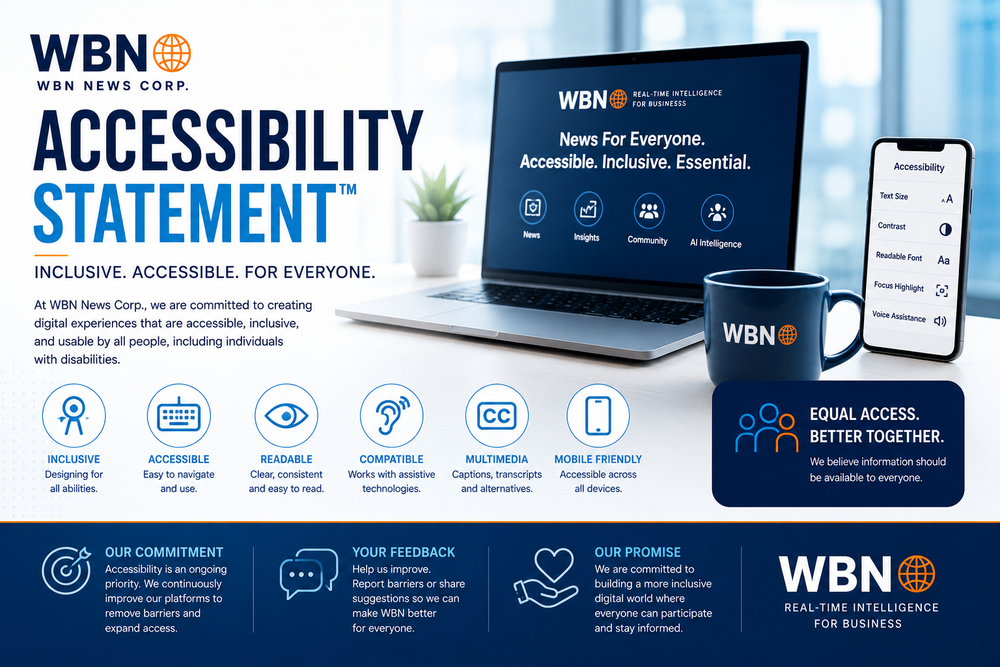
WBN News Corp Inc.™
Accessibility Statement™
v1.0
Launched: June 27, 2026
Last Updated: June 28, 2026
Applies to all WBN News Corp digital platforms, products, and services — including all websites, applications, subscriber portals, and Cast OS™ products.
WBN Accessibility Statement™ v1.0:
Access to quality information should not depend on ability
·
Accessibility is a continuous commitment — not a destination
·
Report a barrier or request assistance: accessibility@wbnn.news
Accessibility Commitment · WBN News Corp Inc.™
WBN is for everyone. The information we produce, the intelligence we deliver, and the platforms we build are most valuable when they are accessible to the widest possible audience — including people who experience the world differently.
This statement explains our approach to digital accessibility — what we are working toward, what we have already done, where we know we have more to do, and how we want to hear from you if you encounter a barrier on any of our platforms. Accessibility at WBN is not a compliance task we complete and set aside. It is a continuous practice that we take seriously and intend to improve, consistently, over time.
Contents
9 sections · Click to navigate
1
Why Accessibility Matters to WBN
WBN News Corp's mission is to inform. That mission has meaning only if the information we produce reaches the people who need it — and that means designing our platforms and products so that everyone, regardless of how they experience the digital world, can access what we publish.
Approximately one in six people globally lives with some form of disability. Many more experience situational limitations that affect how they use digital platforms — reading in bright sunlight, using a device one-handed, learning in a second language, or simply ageing in ways that make certain digital interactions more difficult. Accessibility is not a niche concern. It is a mainstream requirement for any organisation that takes its audience seriously.
For WBN specifically — a global media and intelligence platform operating across multiple countries, cultures, and contexts — the commitment to equal access is also a commitment to the journalists, analysts, business professionals, researchers, and members of the public who rely on our platforms to stay informed and make better decisions. That community is as diverse as the world we cover, and our platforms should reflect that.
Access to quality information is not a privilege. WBN is committed to making its journalism, intelligence products, and community features available to the widest possible audience. Accessibility is how we put that commitment into practice.
2
Our Commitment to Inclusive Design
WBN is committed to designing platforms and products that are genuinely inclusive — not platforms that are technically accessible but practically difficult to use. There is a meaningful difference between compliance on paper and an experience that people with disabilities can actually navigate with confidence and independence. We aim for the latter.
What Inclusive Design Means to Us
Inclusive design at WBN means building accessibility into our products from the beginning — not retrofitting it once a platform is already built. It means testing our platforms with real users, including people who use assistive technologies such as screen readers, voice control, and switch devices. It means making decisions at every stage of product development — from information architecture to colour palette to interactive elements — with accessibility as a genuine design requirement rather than an afterthought.
We recognise that inclusive design benefits not just users with disabilities but the entire user base. Clear navigation, legible typography, consistent structure, and logical content hierarchy make a platform better for everyone — not just for those who need it most. Accessibility and good design are not in tension; they reinforce each other.
Equal Access to Information
WBN produces journalism, business intelligence, and analytical content that has real value for the people who use it. We believe that access to that value should not depend on whether someone uses a mouse, whether they can see colours at full contrast, whether they navigate the web by keyboard rather than pointer, or whether they rely on a screen reader to convert visual content into audio. Equal access is not a courtesy — it is a right that our design and technology choices either support or undermine.
Removing Barriers
WBN is committed to identifying and removing accessibility barriers across its platforms on an ongoing basis. We know we do not yet meet every accessibility standard we aspire to, and we say so honestly in this statement. Where barriers exist, we are working to remove them. Where we discover new barriers — through our own testing, through user feedback, or through changes in platform technology — we add them to our accessibility improvement work and address them as quickly as our resources allow.
3
Our Accessibility Approach & Standards
WBN's accessibility work is guided by internationally recognised best practices for web and digital accessibility. We use these as a practical benchmark — a shared vocabulary for what accessible design looks like — rather than a certification exercise.
Web Content Accessibility Guidelines (WCAG)
The Web Content Accessibility Guidelines (WCAG), published by the World Wide Web Consortium (W3C), provide the most widely adopted framework for accessible digital content. WCAG is organised around four core principles — that web content should be Perceivable, Operable, Understandable, and Robust — and provides specific success criteria at different levels of conformance (Level A, AA, and AAA).
WBN's goal is to work progressively toward meaningful conformance with WCAG 2.1 at Level AA across our platforms. We do not claim full conformance at this time — we are at different stages of accessibility maturity across different products — but WCAG 2.1 AA represents the standard we are actively working toward and using to guide our improvement efforts.
Our Approach in Plain Terms
In practical terms, our accessibility approach means we aim to ensure that our platforms can be used by people who cannot see a screen, people who cannot use a mouse, people who have difficulty distinguishing certain colours, people who need more time to complete tasks, people who process information differently, and people using older or less capable devices. These are not edge cases — they represent a significant and varied portion of any real-world digital audience.
4
What We Work On Across Our Platforms
Accessibility spans every dimension of how our platforms are designed and built. The following describes the key areas of our accessibility practice — what we aim to do, why it matters, and how it improves the experience for users who depend on it.
🧭
Navigation
We aim to provide clear, consistent navigation that is predictable across our platforms — with logical menu structures, skip-navigation options for keyboard users, and clear indicators of where you are within a site.
⌨️
Keyboard Accessibility
All interactive elements on our platforms — links, buttons, forms, menus — should be accessible and operable using a keyboard alone, without requiring a mouse or pointer device. We test keyboard navigation as a standard part of our development process.
🔤
Readable Typography
We use clear, legible typefaces at sizes that support comfortable reading. Our platforms support browser text-size adjustments without breaking the layout, and we avoid relying on very small text for essential content.
🎨
Colour Contrast
We work to ensure that text and interactive elements have sufficient colour contrast against their backgrounds, so that content is readable for users with colour vision deficiencies or low vision. Colour is not used as the sole means of conveying important information.
📱
Responsive Design
Our platforms are designed to work across a range of screen sizes and device types — from desktop monitors to mobile phones — so that users can access our content in whatever way is most comfortable and practical for them.
🖼️
Alternative Text
We aim to provide meaningful alternative text descriptions for images that carry editorial information, so that users relying on screen readers can understand the content of those images without seeing them.
📋
Structured Headings
We use a logical heading structure across our pages and articles — H1, H2, H3 — so that users navigating by heading (a common practice for screen reader users) can move through content efficiently and understand its organisation.
📝
Accessible Forms
Forms on our platforms — for subscription, account creation, event registration, and other purposes — are designed with clear labels, descriptive error messages, and logical tab order, so that they are navigable and usable for all users.
🎬
Multimedia Accessibility
We aim to provide captions for video content and transcripts for audio content where practicable, so that users who are deaf or hard of hearing can access content that would otherwise be unavailable to them. We are expanding this capability progressively.
We are honest about where we are. Not every element across every WBN platform currently meets all of the above standards at all times. Some of our newer products and features are more accessible than older ones. We are continuously improving, and this section describes our goals and active practice — not a claim of complete conformance.
5
AI & Accessibility
WBN is an AI-enabled platform, and we see genuine potential for AI to improve accessibility across our products — both for users who need it most and for the broader audience who benefits from more intelligent, responsive, and personalised experiences.
How AI May Enhance Accessibility at WBN
- Improved search and discovery. AI-powered search can help users find relevant content more quickly and accurately — reducing the cognitive load of navigating large content libraries and surfaces that are most relevant to each individual user's needs.
- Content summaries. AI-generated summaries of complex or lengthy articles and intelligence reports can make content more accessible to users who find extended reading difficult — whether due to cognitive differences, time constraints, or language barriers.
- Language assistance. AI-powered translation and language tools can extend access to WBN's content across language communities, reducing the barrier of English-language-first publishing for readers whose primary language differs.
- Auto-captioning and transcription. AI tools increasingly support automatic captioning of video content and transcription of audio — capabilities we are working to integrate more broadly across WBN's multimedia output.
- Personalised navigation. AI personalisation may allow users to configure their experience on WBN platforms in ways that suit their individual needs — including text size preferences, content format preferences, and notification settings.
AI Does Not Replace Thoughtful Design
AI is a tool, not a solution. The accessibility gains that AI can deliver depend entirely on how it is designed, implemented, and governed. An AI summary that misrepresents an article's content is not an accessibility improvement — it is a different kind of barrier. An automated caption that is inaccurate creates confusion rather than access.
WBN's approach to AI and accessibility is grounded in the same principles of human oversight and quality assurance that govern our AI use more broadly. AI-assisted accessibility features are reviewed for accuracy and effectiveness before deployment and monitored on an ongoing basis. Human-centred design remains the foundation — AI augments it.
6
Known Limitations & Ongoing Work
WBN is committed to transparency about where our accessibility practice falls short of our goals. Acknowledging limitations honestly is more useful to our users than overclaiming conformance we have not yet achieved.
Areas of Active Improvement
- Multimedia captions and transcripts. We do not yet provide captions or transcripts for all video and audio content published on our platforms. We are expanding this capability progressively, with priority given to our most-accessed content.
- Legacy content. Older articles and content published before our current accessibility standards were in place may not fully meet our current goals — particularly with respect to image alt text, heading structure, and document formatting. We review and update high-traffic legacy content as resources allow.
- Third-party embedded content. Interactive content, visualisations, and embedded tools produced by third parties may have accessibility limitations that are outside WBN's direct control. We address this in Section 7.
- Complex data visualisations. Intelligence dashboards and data-rich visualisations are inherently challenging to make fully accessible. We are working to provide text-based alternatives and accessible data summaries alongside visual representations.
Our Improvement Process
WBN evaluates its platforms for accessibility on a regular basis — through both internal reviews and periodic assessments. Where our evaluation identifies gaps against our goals, we prioritise remediation based on the severity of the barrier, the volume of users affected, and the technical complexity of the fix. We do not treat accessibility improvements as optional enhancements — they are part of our normal product development cycle.
We also actively seek user feedback as part of our improvement process. Users who report an accessibility barrier they have encountered are providing us with the most direct and useful information we can receive. We take all such reports seriously. See Section 8 for how to reach us.
7
Third-Party Services
WBN's platforms incorporate services and content provided by third parties — including payment processors, video hosting providers, analytics tools, social media embeds, and interactive data tools. These third-party services operate under their own development and accessibility standards, and WBN does not control their accessibility features or limitations.
Where we have a choice between third-party providers, accessibility is a factor we consider in that decision. We encourage our technology partners and service providers to support accessibility in their products and to align with recognised accessibility standards. Where a third-party integration creates a significant accessibility barrier for our users, we investigate alternatives or supplementary solutions where practicable.
If you encounter an accessibility barrier on a WBN platform that appears to originate from a third-party component, please let us know. Even where the barrier lies outside our direct control, your report helps us understand the impact on our users and allows us to raise the issue with the relevant provider or identify an alternative approach.
8
Tell Us What You Experience
Your experience of our platforms matters to us — and if you encounter a barrier, we want to know about it. Feedback from users who actually encounter accessibility challenges is the most valuable information we receive in this area. It tells us where our own testing missed something, where a change has broken something that was working, and where we have more to do.
How to Reach Us
If you have experienced an accessibility barrier on a WBN platform, have a suggestion for how we could improve our accessibility, or need assistance accessing content in a different format, please contact our accessibility team at accessibility@wbnn.news.
When reporting a barrier, it is helpful — though not required — to include the URL or name of the platform or page where you encountered the issue, a description of what you were trying to do and what happened instead, the assistive technology or browser you were using if relevant, and any other context that might help us understand and reproduce the issue. We aim to acknowledge all accessibility reports within two business days and to respond with a substantive update within ten business days.
Requesting Content in an Alternative Format
If you need access to specific WBN content in a format that our platforms do not currently provide — for example, a text transcript of a video, a plain-text version of a document, or a more accessible format of a data visualisation — please contact us at accessibility@wbnn.news and we will do our best to assist. We cannot guarantee that every alternative format request can be fulfilled for every piece of content, but we will respond honestly and explore what is possible.
We listen. We do not treat accessibility feedback as complaints to be managed. They are signals about our platforms that help us build better products. We are grateful to every user who takes the time to tell us about an accessibility issue they have experienced.
9
Our Continuous Commitment
Accessibility is not a project with an end date. Digital platforms change continuously — new features are added, technologies evolve, standards are updated, and user needs shift. Maintaining meaningful accessibility requires a continuous commitment rather than a one-time effort.
WBN's commitment to accessibility is embedded in how we develop products — it is part of the conversation from initial design through to launch and beyond. Our product teams include accessibility considerations in design reviews, development testing, and post-launch evaluation. Accessibility is not the responsibility of a single team or a single individual — it belongs to everyone who builds and maintains our platforms.
As AI technologies mature, as digital accessibility standards evolve, and as our understanding of what our users need develops further, we expect our accessibility practice to develop with them. We will update this statement when our approach changes materially, and we will continue to be honest about where we are in our accessibility journey — including where we still have significant distance to travel.
This statement was last reviewed and updated on June 28, 2026. Previous versions are available on request.
Contact
♿
Accessibility Team
Report a barrier, request an alternative format, or share feedback on our accessibility:
accessibility@wbnn.news
accessibility@wbnn.news
🤖
AI Governance
Questions about AI-assisted accessibility features:
ai@wbnn.news
ai@wbnn.news
💬
General Enquiries
For any other questions about using our platforms:
community@wbnn.news
community@wbnn.news
🛡️
Trust Centre
All WBN governance documents:
wbnnewscorp.com/trust-centre/
wbnnewscorp.com/trust-centre/
WBN Accessibility Statement™ v1.0 | Launched: 06-27-26 | Updated: 06-28-26 | WBN Cast OS™ v0.3 | WBN News Corp Inc.™