
WBN News Corp Inc.™ · Position Paper No. 3
Bringing Back Local Radio
05-06-26 · Public Edition
What Was Lost
Local Radio Didn't Just Fade Out. It Was Consolidated Away.
For most of the twentieth century, local radio was the most intimate medium in community life. It was the voice in the kitchen at breakfast. The companion on the commute. The first place a community heard about the storm coming, the road closed, the game that went to overtime. It knew the names of the local coaches, the councillors, the business owners who sponsored the afternoon drive. It sounded like the place it came from.
Then the consolidation came. Ownership rules changed. Large media groups bought local stations and replaced local voices with syndicated content and automated playlists managed from headquarters in another city. The call letters stayed on the dial. The community left the building. What remained wasn't local radio — it was national radio wearing a local postal code.
What disappeared wasn't just a station. It was the sound of a community talking to itself. Without it, local events go unannounced. Local emergencies go without a trusted voice. The ambient sense of shared civic life — the feeling that someone is paying attention to this specific place — quietly goes silent.
Why Previous Attempts Failed
The Broadcast Model Is Gone. The Audio Medium Is Not.
Community radio efforts over the past decade came in two forms: low-power FM stations that required licenses, transmitters, and physical infrastructure most communities couldn't afford — and podcast experiments that produced excellent individual episodes but never built the always-on, structured presence that made radio feel like radio.
The gap was never about audio quality or storytelling talent. It was about infrastructure and continuity. Real radio is always on. It has shows, schedules, channels, hosts — a persistent identity that a community can tune into at any moment and find something relevant. Episodic podcasts, however good, don't create that. They create content. Local radio creates presence.
The Old Model
Broadcast license. FM transmitter. Studio infrastructure. On-air talent contracts. Single revenue stream. High fixed costs. Dependent on local advertising markets absorbed by consolidated national ownership.
The WBN Model
No broadcast license required. No transmitter infrastructure. Lean community host team. Multiple revenue streams. Low fixed costs. Embedded directly in the platforms where audiences already listen — always on, always local.
The Solution
WBN RadioCast™ — Community Radio Rebuilt for Now
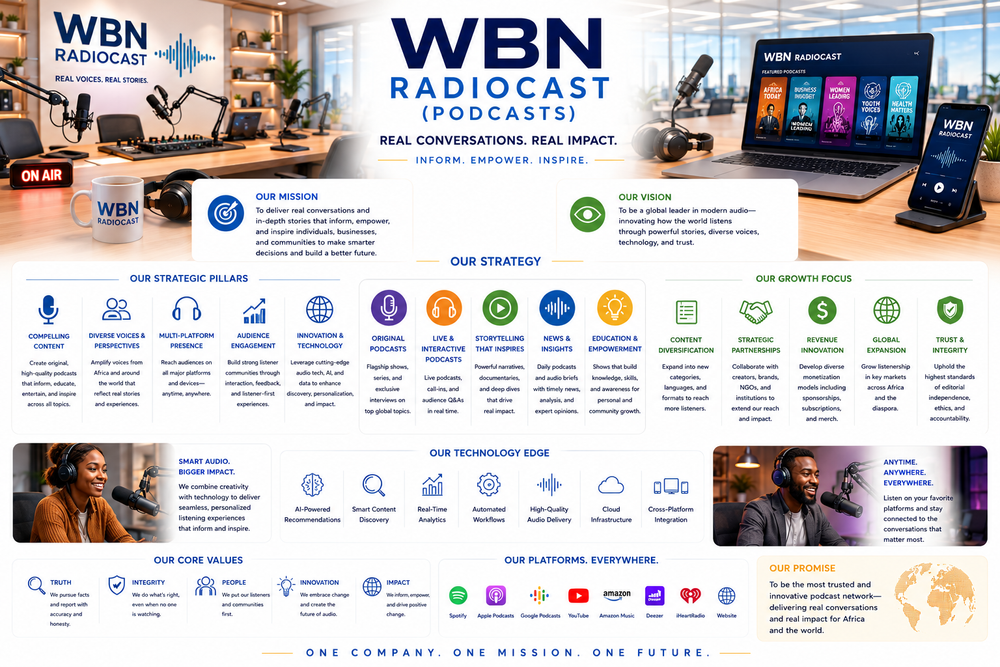
WBN RadioCast™ is not a podcast. The name carries the lineage, but the platform is something different — a community radio station rebuilt for the web. It has the structure, continuity, and always-on presence of real radio, without the transmitter, the license, or the infrastructure that made local radio impossible to sustain at community scale.
Each RadioCast edition is organized around the way community audio actually works — Featured programming for priority coverage, Live Channels for always-on streams, On Demand for archived shows and episodes, Community Voices for submitted content, a Morning Show slot, and a Breaking Audio feed for real-time community announcements. The platform is structured, searchable, and manageable by a small hosting team without any broadcast infrastructure.
Content is managed through a full production system — with sponsor management, listener analytics, community audio submissions, scheduled programming, and role-based access controls. A community can go from silence to a functioning local radio platform in a matter of hours.
The most important design decision in RadioCast™ is also the simplest — it sounds like somewhere. Not a national feed with local tags. Not automated content with a local call sign. A real community voice, embedded in the platforms where people already listen, always on, always present.
The Community Model
Local Hosts. Local Sound. Local Programming Control.
RadioCast™ is not programmed from a distant studio. Each edition is run by people in the community — hosting shows, curating feeds, covering live events with audio, moderating community submissions, and building a station that sounds like the specific place it serves.
Community members can submit audio content directly through the platform for editorial review. Live community events can be broadcast as audio streams with a single toggle. Local emergency and weather alerts feed directly into the Breaking Audio channel. Sponsors are managed locally with full listener analytics. The community controls what goes on air — not a syndication agreement, not a format consultant from another market, not an algorithm optimizing for national reach.
This is what local radio was always supposed to be. A voice that belongs to the place it broadcasts from — not in the legal sense of licensing, but in the real sense of knowing the names, the streets, the teams, and the issues that matter to the people listening.
Technology
Built for Community Audio at Scale
The WBN RadioCast™ platform was built specifically for community radio — not adapted from podcast hosting software or repurposed from music streaming infrastructure. It runs on an integrated technology stack with artificial intelligence embedded throughout, supporting content scheduling, listener analytics, live streaming, and platform administration.
The same platform that powers one community edition powers every edition. Each market gets its own isolated audio environment, its own programming identity, its own community voice — while sharing the underlying infrastructure that makes the whole network stronger and more capable with every new community that joins.
Live Audio Streaming
On Demand Library
Scheduled Programming
Community Audio Submissions
Breaking Audio Alerts
Sponsor Analytics
AI-Assisted Production
Sustainability
Multiple Revenue Streams. From Day One.
The reason local radio failed is not that communities stopped listening. It is that the economics of broadcast infrastructure — transmitters, licenses, full-time on-air staff — required advertising revenue at a scale that only consolidated national ownership could sustain. RadioCast™ was designed from the ground up with multiple revenue streams so that no single source controls the station's survival.
Direct Revenue
Show sponsorship. Pre-roll and mid-roll audio advertising. Live event coverage fees. Premium programming subscriptions. Community membership tiers. Branded content partnerships.
Performance Revenue
Revenue share partnerships — WBN earns a share of what its platform generates for business partners for the life of the relationship. Already operating.
The licensing model means communities don't need to build a studio or carry the cost of a transmitter. They license a proven audio platform, launch their station, and begin generating revenue immediately — at a fraction of what traditional local radio cost to operate.
The Opportunity
Every Community Deserves a Local Station.
Thousands of communities across North America and around the world have lost their local radio voice to consolidation, automation, and the economics of broadcast infrastructure. The dial still exists. The community still listens. But nobody is talking to them — not in the voice of the place they actually live.
WBN RadioCast™ is that voice, rebuilt. It is built, it is running, and it is ready for any community that believes local radio still matters — and that the medium was never the problem. Only the infrastructure was.
The question is no longer whether community radio is possible. It is whether your community is ready to have its own voice back on the air.
WBN CastNetwork™
The Three Pillars of Community Media
WBN RadioCast™ completes the founding trinity of the WBN CastNetwork™. Together, TVCast™, NewsCast™, and RadioCast™ cover every medium through which a community has historically understood itself — television, print, and radio — all rebuilt for the web, all running on the same CastKit™ infrastructure, all designed for community ownership and sustainable economics.
TVCast™ · NewsCast™ · RadioCast™
The three mediums that defined community identity for a century — rebuilt as a unified platform. One CastKit™ infrastructure. Three distinct community voices. Every community covered.
What Comes Next
SportsCast™. BizCast™. CivicCast™. AlertCast™. The CastNetwork™ extends into every vertical that matters to community life — each one built on the same foundation, each one owned by the community it serves.
Past — Archive & History
Present — Live & On Air
Future — AI-Assisted Production
WBN News Corp Inc.™ · CastNetwork™
RadioCast™ · Powered by WBN CastKit™
WBN News Corp Inc.™ · Position Paper No. 3 · Bringing Back Local Radio · 05-06-26
Est. 2026