
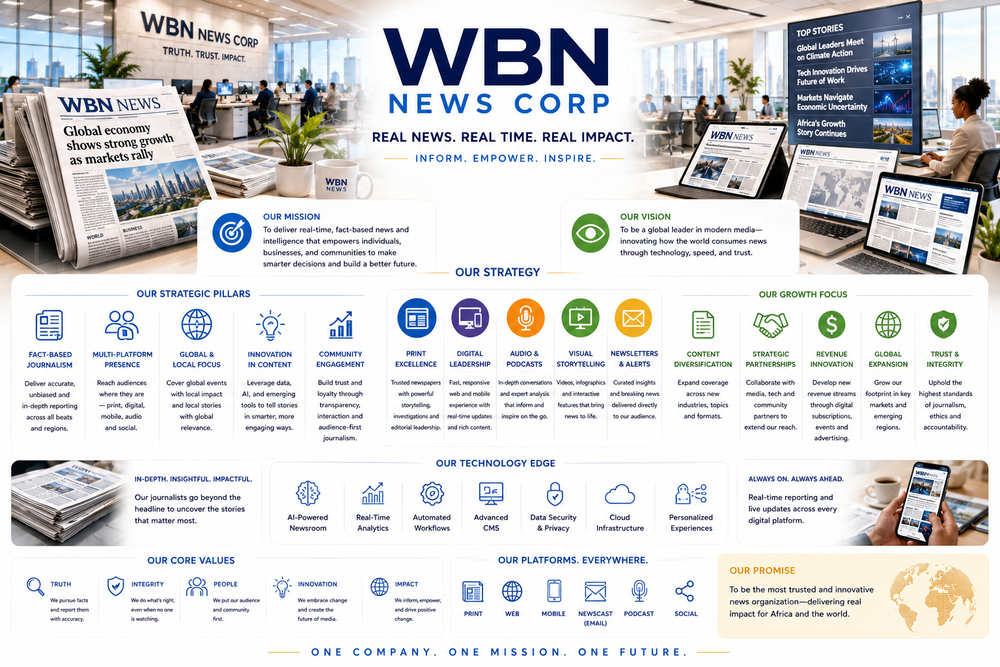
WBN News Corp Inc.™ · Position Paper No. 2
Bringing Back Local Newspaper
05-06-26 · Public Edition
What Was Lost
Local News Didn't Just Disappear. It Was Defunded.
For generations, the local newspaper was the operating system of community life. It published the zoning decision that changed the neighbourhood. It named the school trustee nobody recognized. It ran the obituary that told you the baker on the corner had died. It put the city budget on the front page and forced someone to answer for it. It was how a community knew what was happening — and who was responsible.
Then the economics collapsed. Classified advertising — the financial backbone of most local papers — vanished almost overnight to free online platforms. Display advertising followed, migrating to national and global platforms that could offer targeting at a scale no local publication could match. Revenue fell. Newsrooms shrank. Papers closed. And in community after community, the last local reporter walked out the door and didn't come back.
What disappeared wasn't just a publication. It was the mechanism of local accountability. Without it, councils operate with less scrutiny. Developers build with less oversight. Public money moves with fewer questions asked. The gap left by local journalism is not an inconvenience — it is a structural failure in democratic life.
Why Previous Attempts Failed
The Old Model Can't Be Saved. A New One Has To Be Built.
The attempts to rescue local newspapers over the past two decades followed the same playbook: cut staff, reduce print frequency, shrink the newsroom, raise the subscription price, and hope the costs fall fast enough to match the revenue. They didn't. The cost reductions destroyed the product. The product decline destroyed the readership. The readership decline destroyed what remained of the advertising.
The problem was never the journalism. It was the infrastructure it was built on. Print production, physical distribution, legacy CMS systems, large editorial hierarchies — all designed for a world where the newspaper held a near-monopoly on local information. That monopoly is gone. The infrastructure that depended on it has to go with it.
The Old Model
Print production. Physical distribution network. Legacy editorial CMS. Large newsroom overhead. Single revenue stream. High fixed costs. Dependent on classified and display advertising markets it no longer controls.
The WBN Model
No print infrastructure required. Digital-native publishing. Lean community editorial team. Multiple revenue streams. Low fixed costs. Embedded directly in the platforms where local audiences already read.
The Solution
WBN NewsCast™ — Community Journalism Rebuilt for Now
WBN NewsCast™ is not a digital replica of a print newspaper. It does not require a printing press, a distribution fleet, or a legacy CMS that predates social media. It is a community journalism platform — purpose-built for the web, embedded directly inside the digital spaces where a community already reads, and managed by the community's own editorial voice.
Each NewsCast edition is organized around the way community news actually works — Featured stories for priority coverage, Topic Channels for always-on beats, Archives for searchable historical record, a Public Notice board, Community Voices for contributed content, and a live feed for breaking developments. The platform is structured, searchable, and manageable by a small editorial team without any print infrastructure.
Content is published and managed through a full editorial system — with sponsor management, readership analytics, community story submissions, and role-based access controls for editors, contributors, and administrators. A community can go from nothing to a functioning local news platform in a matter of hours.
The most important design decision in NewsCast™ is also the simplest — it meets the reader where they already are. No subscription portal to navigate. No app to download. No paywalled homepage to find. Local journalism comes to the community, embedded in the platforms they already use every day.
The Community Model
Local Reporters. Local Stories. Local Editorial Control.
NewsCast™ is not edited from a distant city desk. Each edition is managed by people in the community — assigning coverage, publishing stories, moderating community contributions, and building a publication that reflects what actually matters in that specific place.
Community members can submit stories and tips directly through the platform for editorial review. Public notices are published automatically from municipal feeds. Sponsors are managed locally with full readership analytics. The community controls what appears in its own publication — not an algorithm, not a wire service, not a chain editor deciding from three time zones away what counts as local news.
This is what local journalism was always supposed to be. Editorially rooted in the place it covers — not in the legal sense of ownership, but in the practical sense of presence, accountability, and genuine commitment to the audience it serves every day.
Technology
Built for Community Journalism at Scale
The WBN NewsCast™ platform was built specifically for community journalism — not adapted from enterprise CMS software or repurposed from national media tools. It runs on an integrated technology stack with artificial intelligence embedded throughout, supporting editorial workflow, readership analytics, and platform administration.
The same platform that powers one community edition powers every edition. Each market gets its own isolated data environment, its own editorial identity, its own community voice — while sharing the underlying infrastructure that makes the whole network stronger and more valuable with every new community that joins.
Breaking News Alerts
Topic Channel Beats
Community Submissions
Public Notice Board
Sponsor Analytics
Role-Based Editorial Access
AI-Assisted Workflow
Sustainability
Multiple Revenue Streams. From Day One.
The reason local journalism failed is not that communities stopped valuing it. It is that the business model depended on revenue streams — print classifieds, display advertising — that vanished to platforms offering greater reach at lower cost. NewsCast™ was designed from the ground up with multiple revenue streams so that no single source controls the platform's survival.
Direct Revenue
Section sponsorship. Targeted display advertising per beat. Event coverage partnerships. Community membership subscriptions. Public notice publishing fees. Sponsored content programs.
Performance Revenue
Revenue share partnerships — WBN earns a share of what its platform generates for business partners for the life of the relationship. Already operating.
The licensing model means communities don't need to build a newsroom from scratch or carry the cost of print. They license a proven editorial platform, launch their edition, and begin generating revenue immediately — at a fraction of what traditional local journalism cost to sustain.
The Opportunity
Every Community Deserves a Local Voice.
Thousands of communities across North America and around the world are now news deserts — places where no journalist covers city hall, no reporter attends the school board meeting, no publication holds local institutions to account. Not because those communities don't have stories worth telling. Because nobody has built a platform that makes local journalism financially sustainable at community scale.
WBN NewsCast™ is that platform. It is built, it is running, and it is ready for any community that believes local journalism still matters.
The question is no longer whether community journalism is possible. It is whether your community is ready to have its own voice back.
WBN CastNetwork™
Information That Knows Where It's Going
WBN NewsCast™ is part of the WBN CastNetwork™ — a new kind of community intelligence channel built for the way information actually moves. Topic-focused. Always on. Community-powered. Embedded directly inside the platforms where audiences already read.
Past — Archive & Record
Present — Live & Breaking
Future — AI-Assisted Insight
WBN News Corp Inc.™ · CastNetwork™
NewsCast™ · Powered by WBN CastKit™
WBN News Corp Inc.™ · Position Paper No. 2 · Bringing Back Local Newspaper · 05-06-26
Est. 2026